TCB Jeans
TCB Jeans_Uncle Cat Shirt_Betashan
TCB Jeans_Uncle Cat Shirt_Betashan
Couldn't load pickup availability
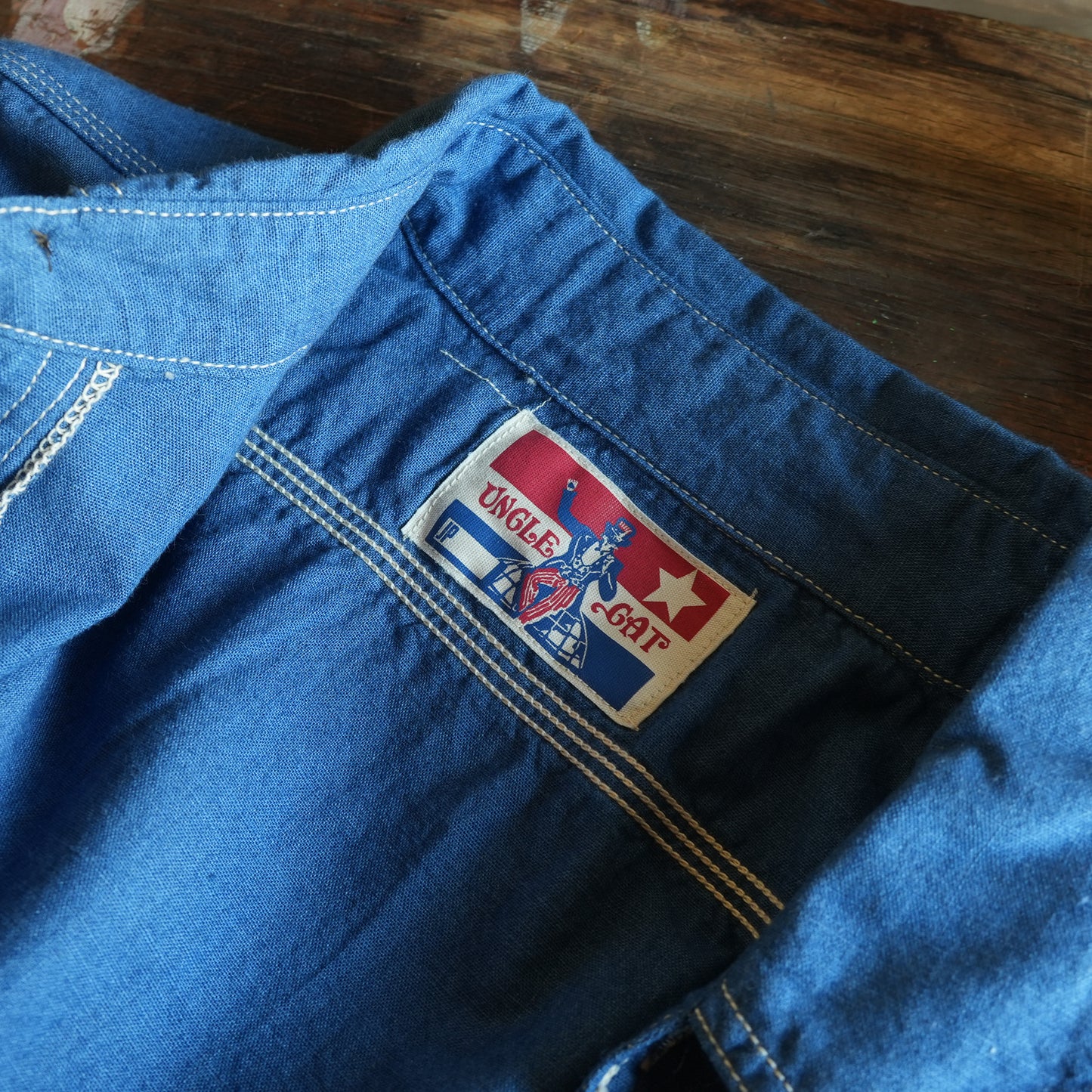
We've recreated an UNCLE SAM Vintage Shirt from the 1940s.
It features asymmetrical chest pockets, commonly known as "gacha-poke."
The left chest has the E-Z REACH POCKET, which I personally love.
This design, patented in 1937,
is a two-tiered structure with one pocket layered over another.
While it certainly increases storage capacity, it was also intended to protect cigarettes, which were not yet film-wrapped at the time, from body sweat and moisture.
Today, it looks like a design.
But back then, there was a proper reason for it.
I think this is what makes vintage workwear so interesting.
The pen holder section has a shirt buttonhole.
And the eye-catching red bartack stitched at the corner of the pocket.
TCB deliberately made this yellow. TCB doesn't make many work shirts normally.
So, if we're going to make one,
we chose a half-zip type this time.
Vintage versions used TALON zippers, but considering strength and stability for modern clothing, we had some reservations. So, TCB opted for Waldes.
And what's interesting is the bottom stop of the zipper.
Generally, box-shaped stops are common, but the vintage piece we referenced used a bottom stop that looked truly like underwear, commonly called a "pants stop." I found myself strangely fond of it, so TCB also adopted the pants-shaped bottom stop.
Vintage shirts have quite long body lengths.
At TCB, you can tuck it in if you want.
But it's also balanced when worn untucked.
We modified the length and sizing to achieve this.
And one more thing I'd like you to notice is the bobbin thread in the stitching.
Sometimes seen in vintage coveralls, the chain stitching in triple-stitched felled seams and the bobbin thread in pockets are sometimes made with colorful threads.
We considered using random colorful threads at TCB as well.
But this time, we picked up each "seemingly random thread usage" from the vintage piece.
This color here. Next, this color.
The stitching uses the same color scheme as the vintage piece we referenced.
Please pick it up and turn the shirt inside out to check when you get it.
And.
When I hear "half-zip work shirt," an anecdote comes to mind.
Over twenty years ago,
I listed a certain brand's half-zip work shirt on Yahoo Auctions.
At the time, Yahoo Auctions would disclose the buyer's personal information once an item was won, and then it was up to the individuals to handle the rest.
Checking the successful bidder's address, it was Kojima.
Extremely close.
A few months after the transaction, for some reason, I suddenly contacted him, and we ended up going out for a meal. There, I met Mr. Tateno, who would later found WORKERS.
The catalyst was neither TCB's clothing nor WORKERS' clothing.
It was a single half-zip work shirt.
Just like two zipper halves interlocking, it brought us together. The fact that it was a half-zip, not a full-zip, somehow feels like us (laughs).
A meeting like "Notting Hill" or "You've Got Mail."
…though it was two men (laughs).
I hope that, in the future, the clothes we make will continue to be the reason why people around the world meet. I'd be happy if such moments are created.
With that wish in mind,
Uncle Cats is now on sale.
□ Fabric
What is known as "beta chambray," seen in 1950s Vintage.
This shirt's fabric was created by TCB as an original, based on that vintage beta chambray.
The indigo is 20-count single yarn for both warp and weft.
It's a lightweight 4.4oz fabric.
General chambray uses dyed yarn for the warp and white yarn for the weft.
This results in a speckled, light appearance on the surface.
Beta chambray, on the other hand, uses dyed yarn for the weft as well.
Its characteristic is that white specks are less likely to appear on the surface, creating a solid, subdued look. However, what we wanted to create this time was not simply "fabric dyed entirely in the same blue."
The warp uses rope-dyed indigo.
The weft uses cheese-dyed sulfide dye.
Furthermore, we've introduced a slight difference in concentration between the warp and weft.
If the warp and weft settled into exactly the same color, it would become a flat blue.
But by leaving a slight color difference, a deep blue emerged within the matte texture. As you can see in the photo, it's not a mottled look like white-thread chambray, but rather blues layered within blue.
And another important aspect this time was "horizontal slub."
When examining old chambray, some pieces exhibit a distinctive horizontal slub. We theorized that this might be due to the way threads were used back then.
During weaving, warp threads, which are subjected to strong tension, require relatively uniform and strong yarn. On the other hand, weft threads don't experience as much tension as warp threads, so slightly slubby, loosely twisted yarns could have been used.
Perhaps those bulky and uneven weft yarns were woven directly into the fabric's texture. Especially in the case of beta chambray, since dyed yarn is also used for the weft, as it's worn, the color gradually wears off the raised parts of the slubs. This results in the horizontal slubs becoming more richly pronounced.
We aimed for this texture with the current fabric.
Currently, the quality of raw cotton and spinning precision are high, so simply using loosely twisted yarn doesn't easily produce the kind of slub seen in the past. Therefore, for the weft, we deliberately designed a fine count yarn that possesses strong and long slub shapes.
The unevenness that old threads had as a result is intentionally woven in this time. As you wear it more, the vertical fading and horizontal slub will intersect.
We believe you'll enjoy the unique aging of this fabric.
The black version was deliberately made heavier than vintage.
The black parts of the warp use 20-count single yarn with sulfide cheese dyeing.
The off-white parts use 40-count two-ply yarn, twisted together to form a heathered yarn.
By deliberately varying the thickness of the black and off-white threads, natural irregularities are created when they become a single yarn. These irregularities appear as a vintage-like depth when woven into fabric.
The weft uses 10-count single yarn, also with sulfide cheese dyeing.
Furthermore, by weaving it at a high density, we achieved a substantial thickness of 9.5oz.
It has a weight that could be used for a coverall, let alone a shirt.
It has a roughness and weight unique to black heather, different from the blue beta chambray.
Even with the theme of beta chambray, the indigo is light, with depth of blue.
The black is heavy, with the unevenness of the heather.
Both are not merely copying vintage, but rather TCB's current interpretation of the nuances and appeal felt from vintage, translated into fabric.
It's quiet at first, but develops character as you wear it.
We believe we've achieved such a fabric.
Above, reprinted from the official manufacturer's information
Spiral Comment
At first glance, it's a simple half-zip work shirt, but the details are packed with the ingenuity unique to 1940s workwear.
Each feature, such as the asymmetrical "gacha-poke," the E-Z REACH pocket designed to protect cigarettes from moisture, and the colorful sewing threads faithfully reproduced from vintage, has a reason rooted in a time when practicality was paramount.
Furthermore, TCB's original beta chambray fabric develops a unique character as it's worn, with vertical fading and horizontal slub intersecting.
This is a TCB-らしい piece that can be enjoyed by both vintage connoisseurs and those encountering it for the first time.
Personally, the half-zip is a fun item that can be used in various coordinations. A classic Henley T-shirt or a colorful striped T-shirt underneath would work well. Peeking a bandana out is also a nice touch.
Spiral Note What is an E-Z REACH pocket?
It's a workwear pocket structure patented in 1937.
It features a double-layered design with another small pocket layered over a regular chest pocket, not only increasing storage capacity but also serving to protect cigarettes, which were not film-wrapped at the time, from sweat and moisture.
While it appears as a unique design today, all its details were born out of practicality back then.
Spiral Note What is Beta Chambray?
"Beta chambray" is an abbreviation for "betashanburē."
General chambray uses white weft threads, resulting in a light, mottled appearance. Beta chambray, on the other hand, uses dyed threads for the weft as well, so white is less noticeable, and it's characterized by a calm, solid appearance.
TCB further combines different dyeing methods for the warp and weft, creating a fabric that allows you to enjoy unique aging with vertical fading and horizontal slub appearing as it's worn.
Indigo rope-dyed warp and sulfur cheese-dyed weft, right? It makes you excited to see what kind of aging you can enjoy.
Size Chart / サイズ表
Measurements are taken by Spiral after one wash. Please compare them with a similar garment you own.
掲載サイズは、Spiralにてワンウォッシュ後の実物を計測しています。お手持ちの衣類と比較してください。
| サイズ Size |
34 | 36 | 38 | 40 | 42 | 44 | 46 |
|---|---|---|---|---|---|---|---|
| 肩幅 Shoulder |
38.5 cm 15.2 in |
40.5 cm 15.9 in |
42.3 cm 16.6 in |
45.3 cm 17.8 in |
46.3 cm 18.2 in |
48.8 cm 19.2 in |
50.5 cm 19.9 in |
| 着丈 Body Length |
68.5 cm 27.0 in |
70.0 cm 27.6 in |
70.5 cm 27.8 in |
71.3 cm 28.1 in |
73.5 cm 28.9 in |
75.5 cm 29.7 in |
76.5 cm 30.1 in |
| 身幅 Chest |
51.5 cm 20.3 in |
54.0 cm 21.3 in |
56.5 cm 22.2 in |
59.0 cm 23.2 in |
60.5 cm 23.8 in |
62.5 cm 24.6 in |
65.3 cm 25.7 in |
| 袖丈 Sleeve Length |
60.0 cm 23.6 in |
61.5 cm 24.2 in |
63.5 cm 25.0 in |
66.0 cm 26.0 in |
65.3 cm 25.7 in |
66.0 cm 26.0 in |
67.0 cm 26.4 in |
| 袖口幅 Cuff Width |
9.3 cm 3.7 in |
9.3 cm 3.7 in |
9.5 cm 3.7 in |
10.3 cm 4.1 in |
10.3 cm 4.1 in |
11.3 cm 4.4 in |
11.8 cm 4.6 in |
Please note that measurements may vary slightly depending on the individual garment.
製品ごとに若干の個体差が生じる場合がございます。
Trying on at the store
Trying on at the store
In-store try-ons are offered as a service to customers who are considering purchasing from our store.
Please refrain from trying on items solely for the purpose of size confirmation.
Items such as cut-and-sew garments, which are prone to stretching, cannot be tried on. Exchanges after trying on at home post-purchase are also not accepted.
Please also refrain from trying on belts, as they tend to stretch. For length confirmation, please bring a belt you are currently using.
For leather boots and sandals, try-ons are also offered on the premise of purchase. Please try them on during the final confirmation stage. When trying on, please be careful not to cause wrinkles. Please be sure to bring your own socks.
We appreciate your understanding and cooperation to ensure everyone can enjoy using our services comfortably.
No Forwarding Services
No Forwarding Services
We do not ship to freight forwarding addresses.
Please note that if the shipping address provided is identified as a freight forwarder after an order has been placed, your order will be cancelled.
Customs Duties & Taxes
Customs Duties & Taxes
Please note that international orders may be subject to customs duties, taxes, and import fees upon arrival in your country. These charges are the responsibility of the recipient and are not included in the item price or shipping cost.
We recommend checking with your local customs office for more information about applicable fees before placing your order.
International Shipping
International Shipping
Please note that the international shipping cost shown at checkout is an estimate. After your order is placed, we will calculate the exact shipping cost based on the destination, package size, and weight.
- If the actual shipping cost is lower than the estimated amount, we will adjust the shipping charge to the correct amount and finalize your payment accordingly.
- If the actual shipping cost is the same as the estimated amount, your order will be processed without any changes.
- If the actual shipping cost is higher than the estimated amount, we will contact you before processing your order.
- Please note that some destinations may be subject to a Remote Area Surcharge imposed by the shipping carrier. If applicable, only the actual surcharge charged by the carrier will be billed separately.
Please note that the international shipping cost shown at checkout is an estimate. After your order is placed, we will calculate the exact shipping cost based on the destination, package size, and weight.
- If the actual shipping cost is lower than the estimated amount, we will adjust the shipping charge to the correct amount and finalize your payment accordingly.
- If the actual shipping cost is the same as the estimated amount, your order will be processed without any changes.
- If the actual shipping cost is higher than the estimated amount, we will contact you before processing your order.
- Please note that some destinations may be subject to a Remote Area Surcharge imposed by the shipping carrier. If applicable, only the actual surcharge charged by the carrier will be billed separately.
Customs Declaration
Customs Declaration
We are unable to declare a lower value on customs invoices or shipping documents, regardless of customer request.
Accurate customs declarations are required by law. Declaring a false value may violate the import laws and regulations of the destination country. We appreciate your understanding and cooperation.
当店では、お客様のご要望であっても、インボイス(税関申告書)や発送書類に記載する商品価格を実際の購入金額より低く設定することはお断りしております。
正確な税関申告は法律上の義務であり、虚偽の申告は輸入国の法律や規制に違反する可能性があります。何卒ご理解くださいますようお願いいたします。
Share