TCB Jeans
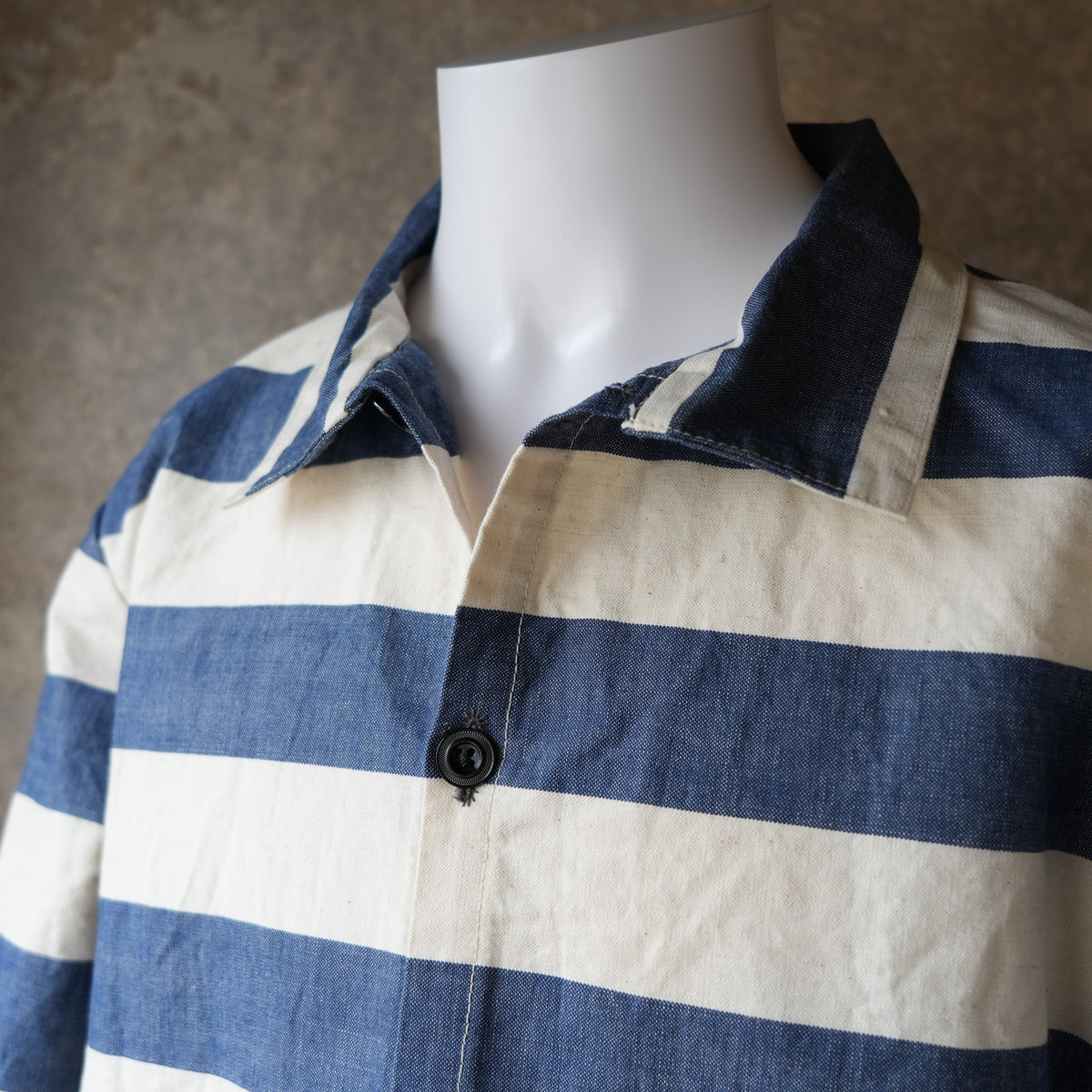
TCB Jeans_Sing Sing Cabaret Jacket
TCB Jeans_Sing Sing Cabaret Jacket
Couldn't load pickup availability
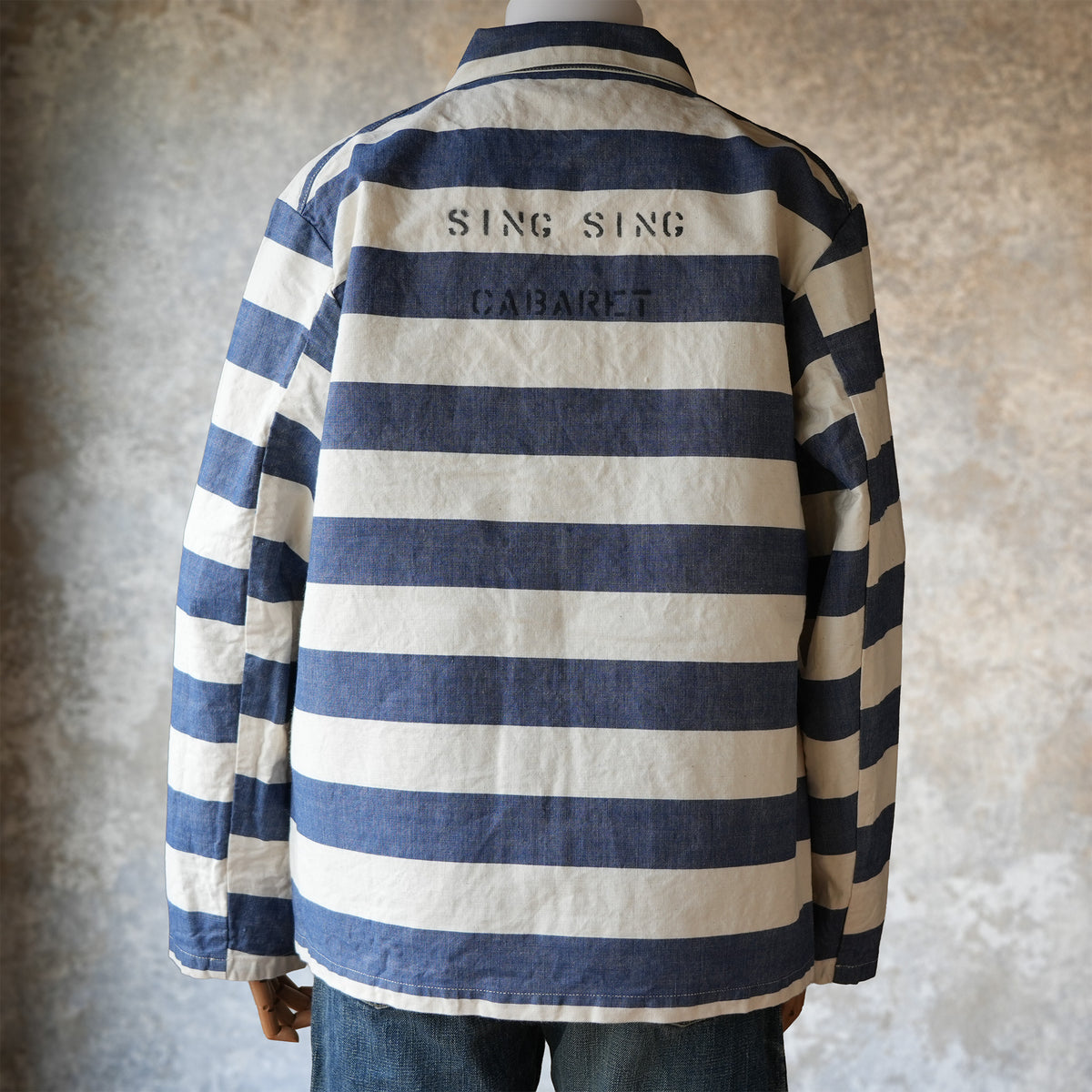
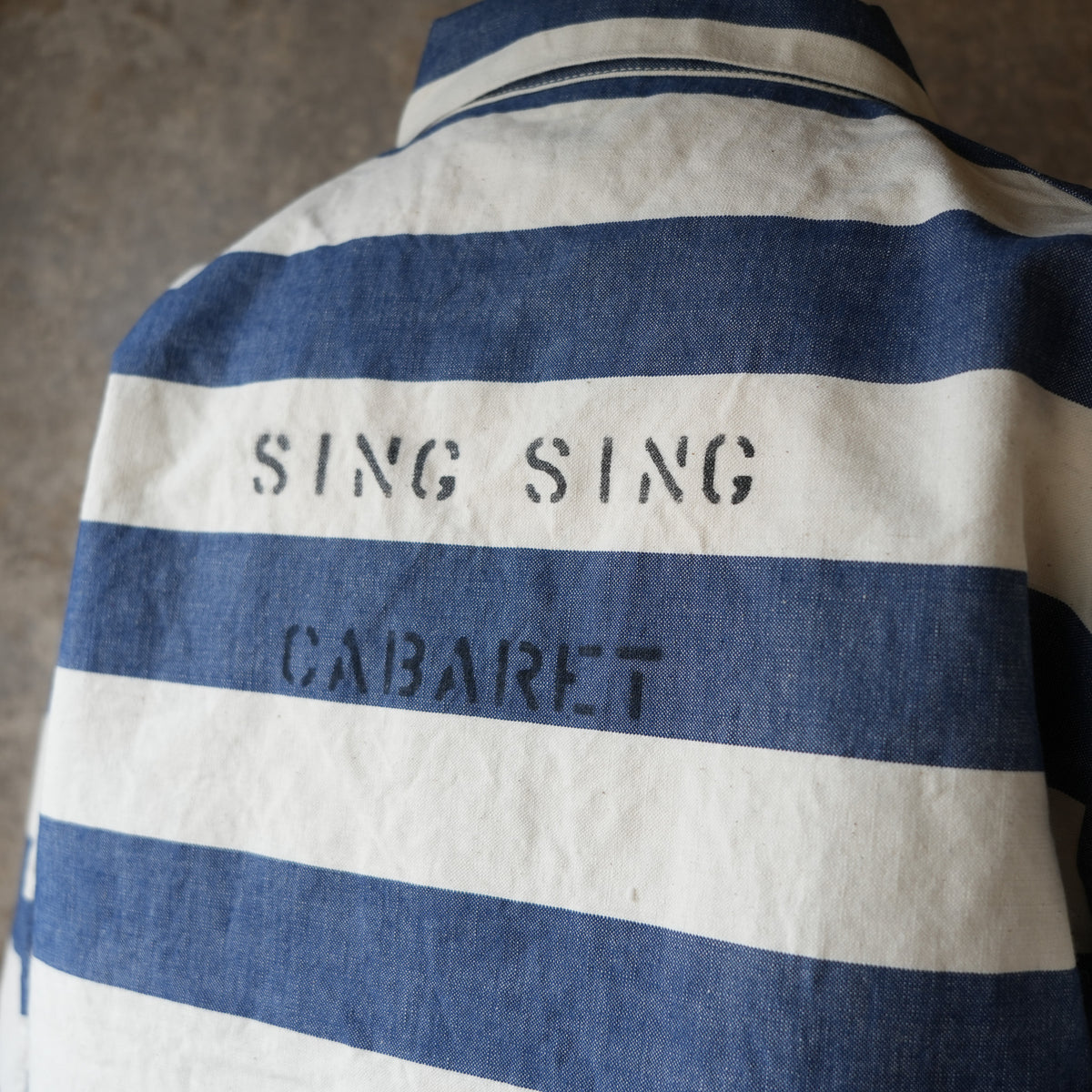
TCB has recently acquired a piece of what is estimated to be 1940s prison attire. The moment I saw the large stencil on the back, my eyes were drawn to the words "SING SING" written alongside a prisoner number.
At first, I thought it meant "to sing," but upon looking it up, I discovered it refers to the real-life Sing Sing Prison in New York State. I realized where I had heard the name before: the opening scene of the Audrey Hepburn film, Breakfast at Tiffany's.
"I've always thought it was a funny name for a prison, Sing Sing. Like an opera house."
While the English line says "opera house," the Japanese subtitles translate it as:
"Sing Sing... like a cabaret."
This translation of "like a cabaret" left a strangely lasting impression on me.
When I was discussing this with RYO, he asked,
"Then, shall we call it the 'SING SING CABARET'?"
After the war, American sewing machines were imported to Japan, and domestic denim production began. At that time, this film was translated into Japanese, and perhaps due to the social context of the era, the term "cabaret" was used because "opera house" was unfamiliar to Japanese audiences. As TCB, a brand dedicated to traditional manufacturing, and because we are a Japanese brand, I became drawn to this stencil—SING SING CABARET—and this jacket.
A cabaret = a place of expression.
Conversely, a prison uniform = a symbol of restriction and rules.
I felt that this combination of conflicting images was quintessentially TCB.
When I closely examined the vintage prison uniform I actually acquired, I found it fascinating. The world of workwear is always haunted by "efficiency for sales" and the "battle with costs," but this prison uniform was "clothing not intended for sale" in the first place.
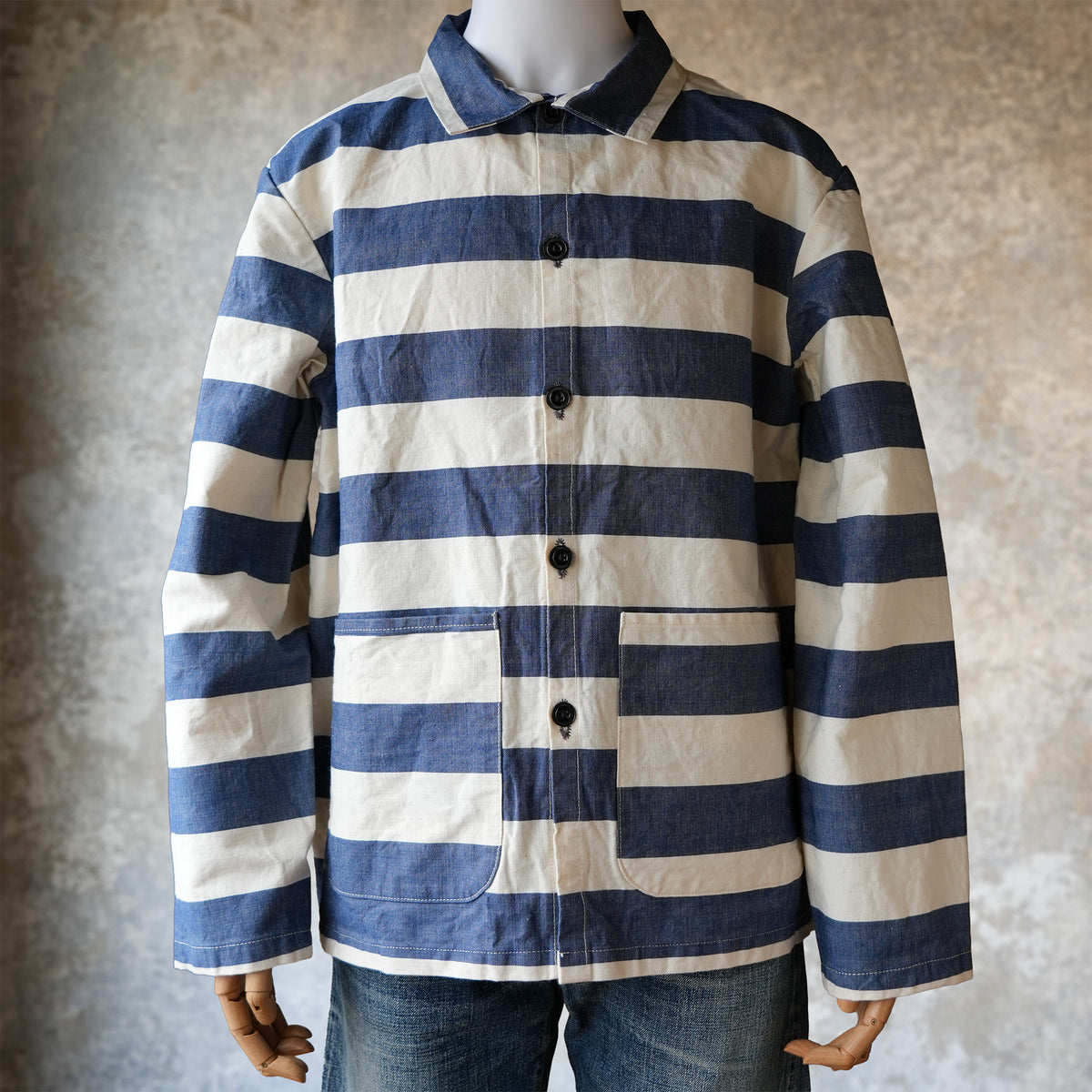
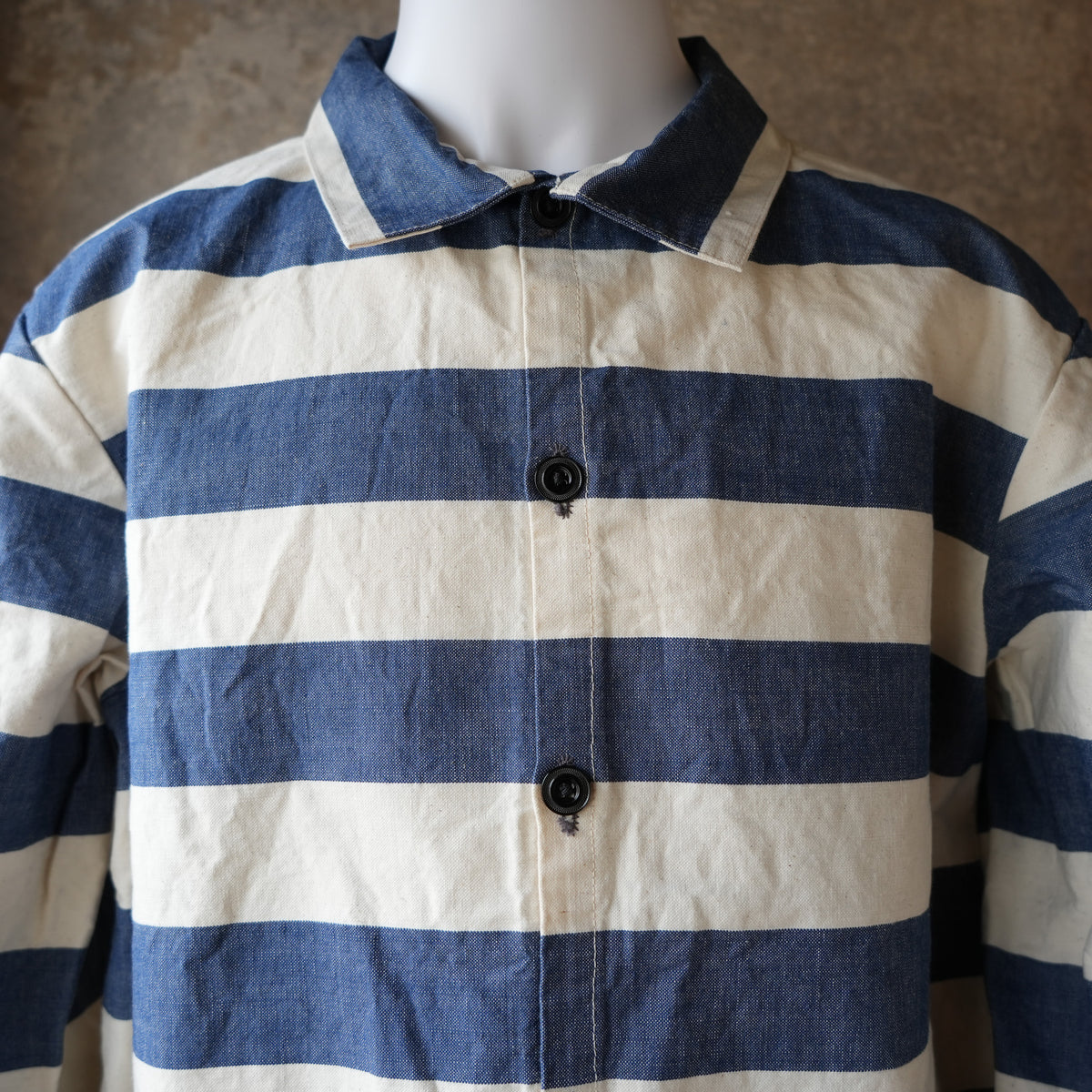
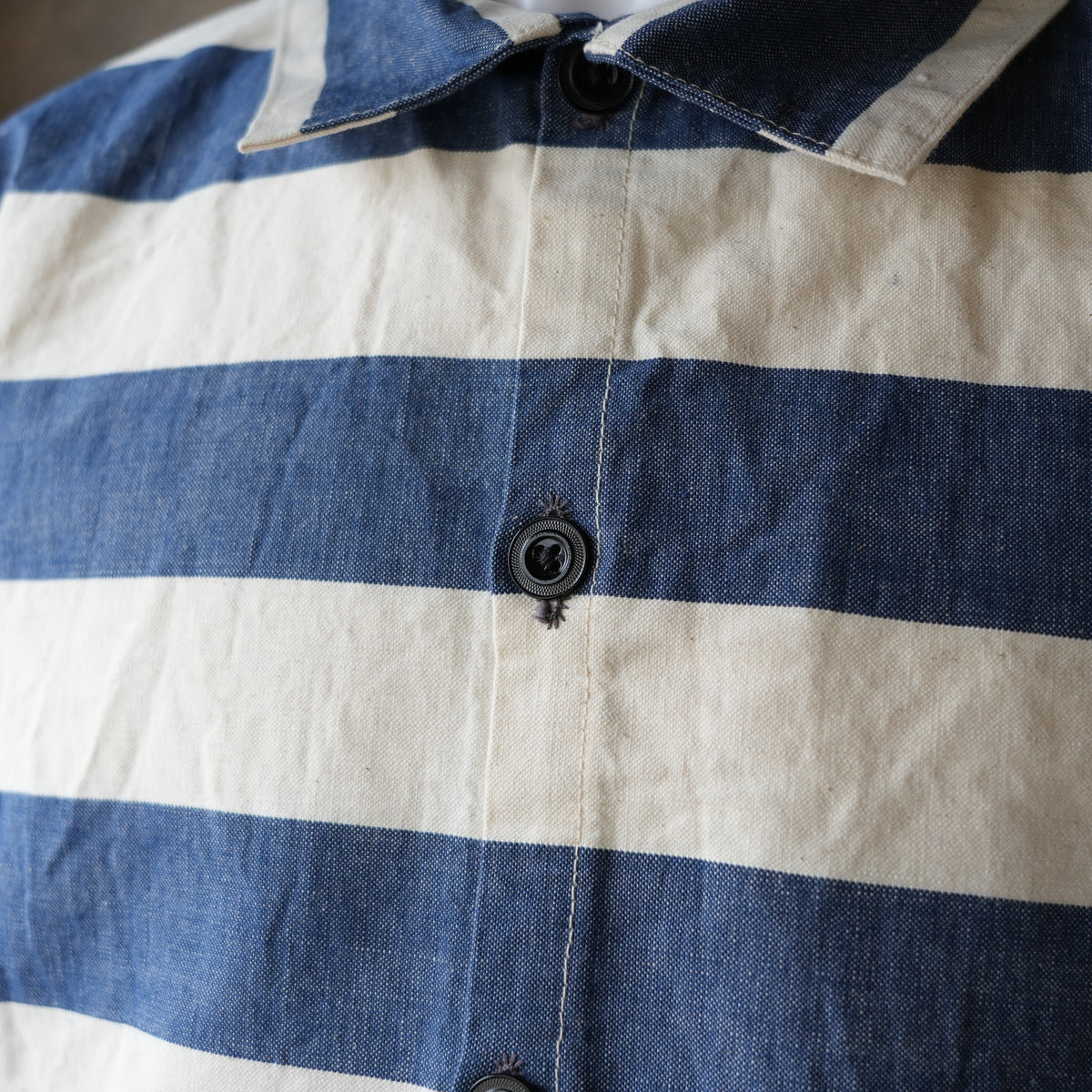
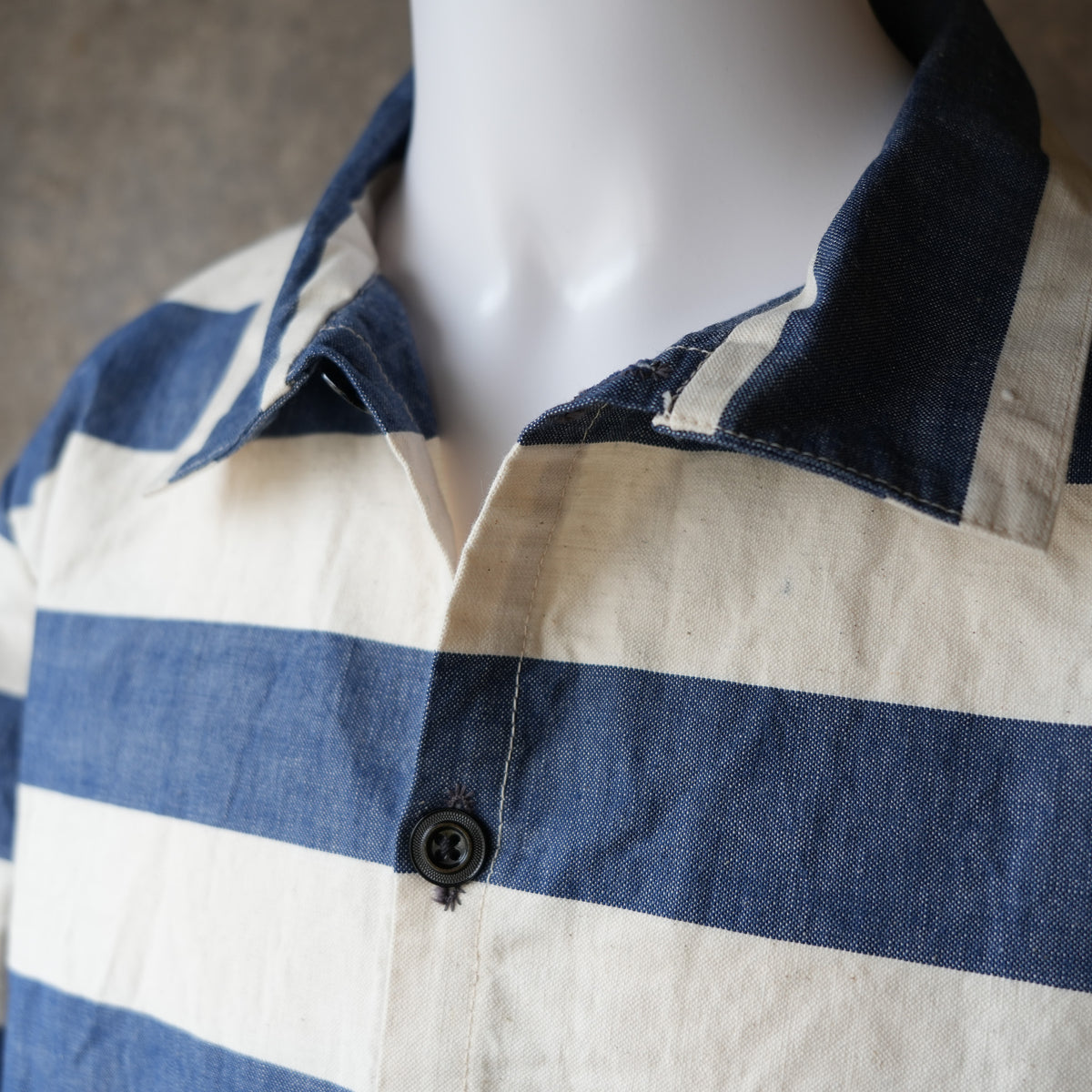
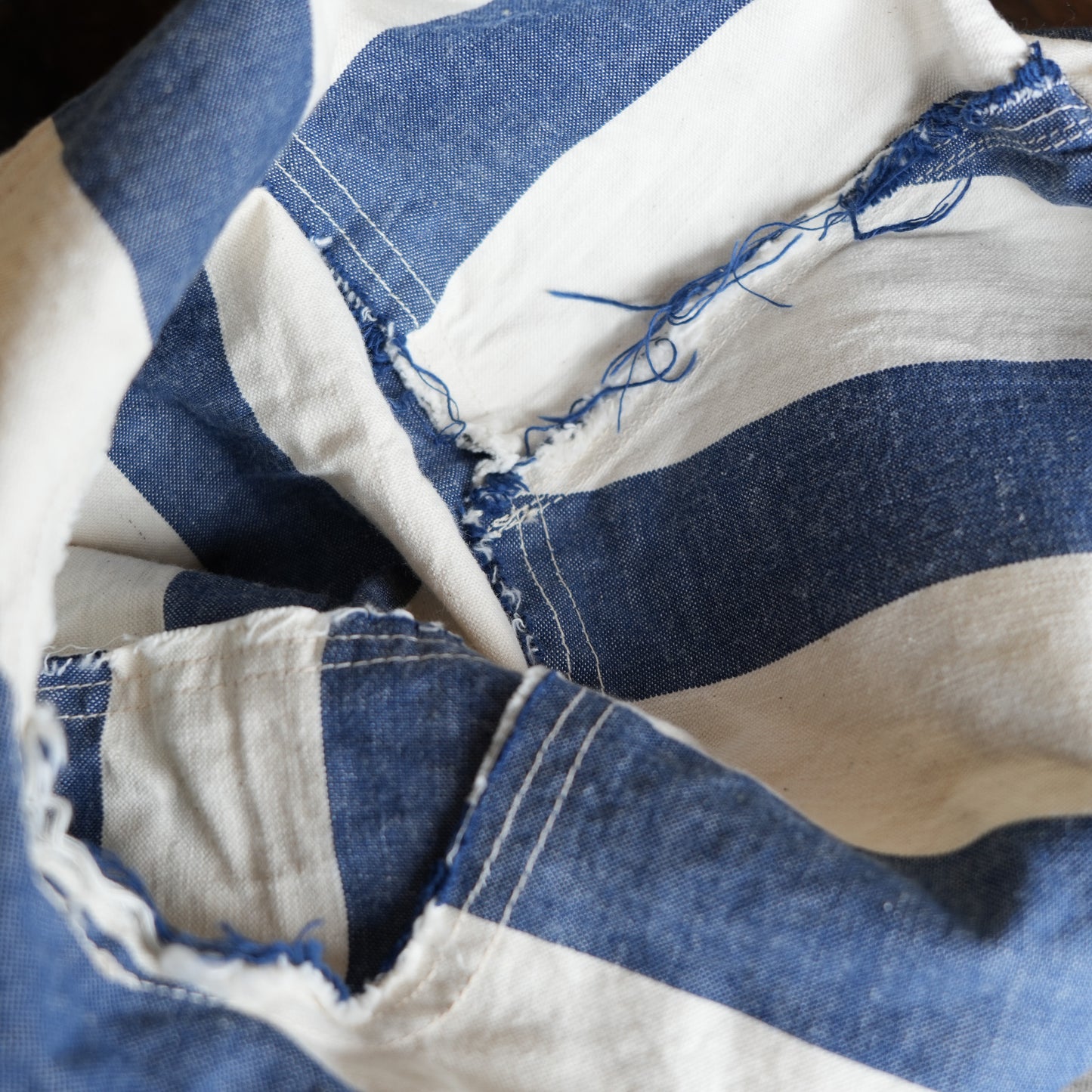
The seams were neither felled nor overlocked. It was simply joined from the inside and sewn with a single straight stitch. I struggled with how to recreate this at TCB, but for this piece, I dared to use that same straight-stitch construction, leaving the seam allowances fringed. I’ve retained a realistic "roughness" so you can feel the atmosphere of the time.
The same goes for the design.
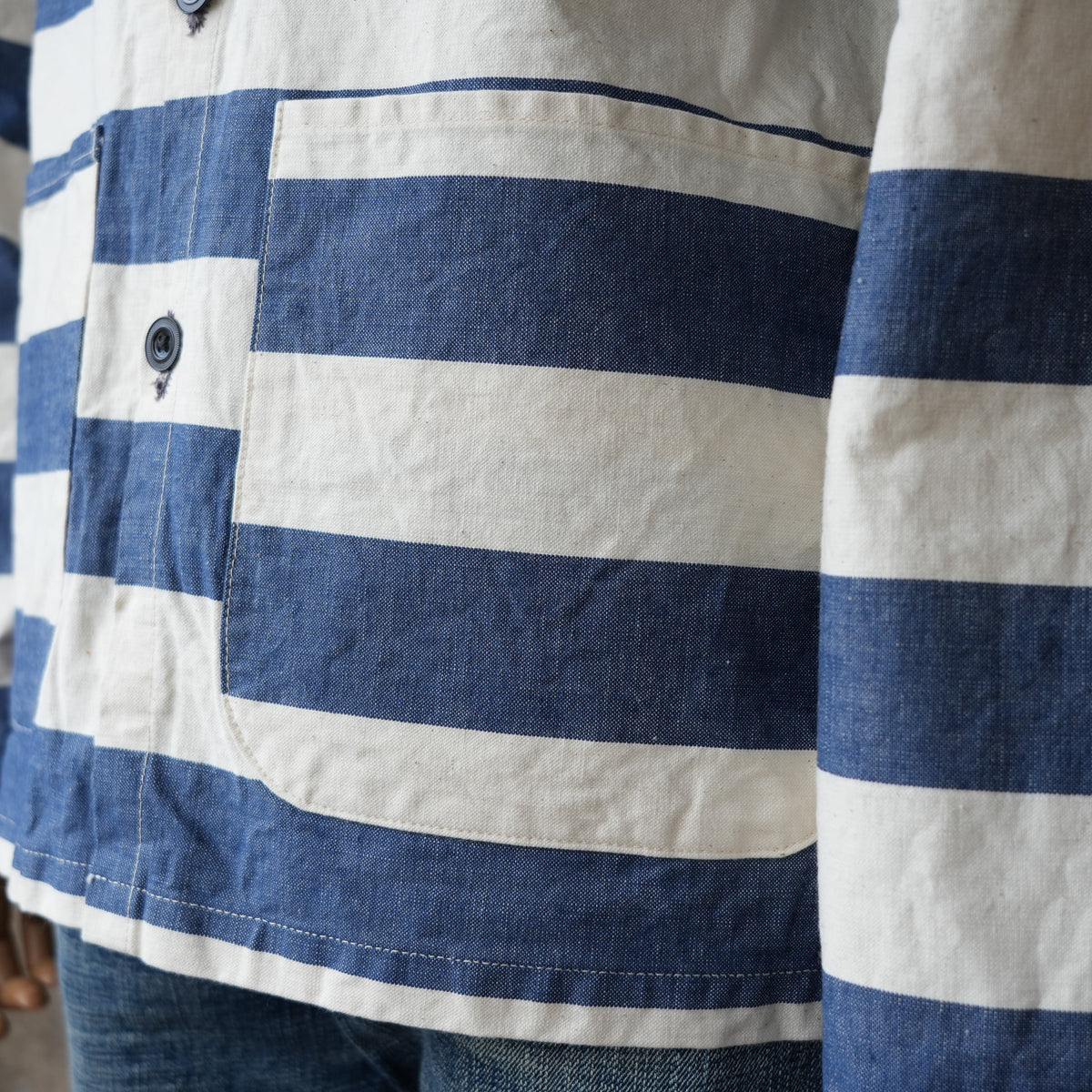
There are absolutely no pockets, so that nothing could be hidden. I figured it would be a bit inconvenient in the outside world today, so at TCB, we added pockets.
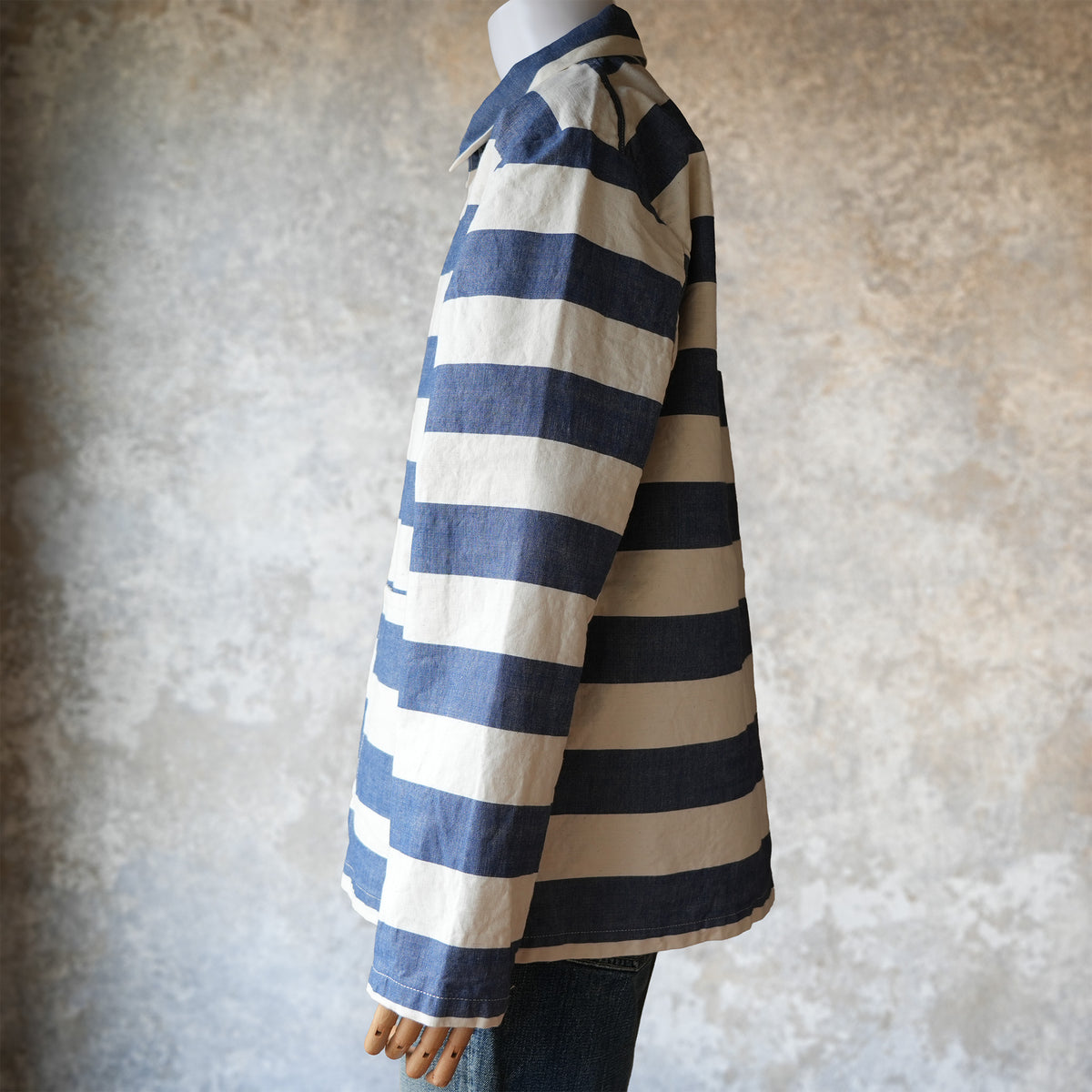
The cuffs are also very wide, measuring about 19cm. Was this also to "prevent the hiding of contraband"? I hesitated to change it, but for the sake of the silhouette and daily wearability, I adjusted the width so you wouldn't have to worry about getting them dirty while eating.
Another thing that struck me was the "pattern matching."
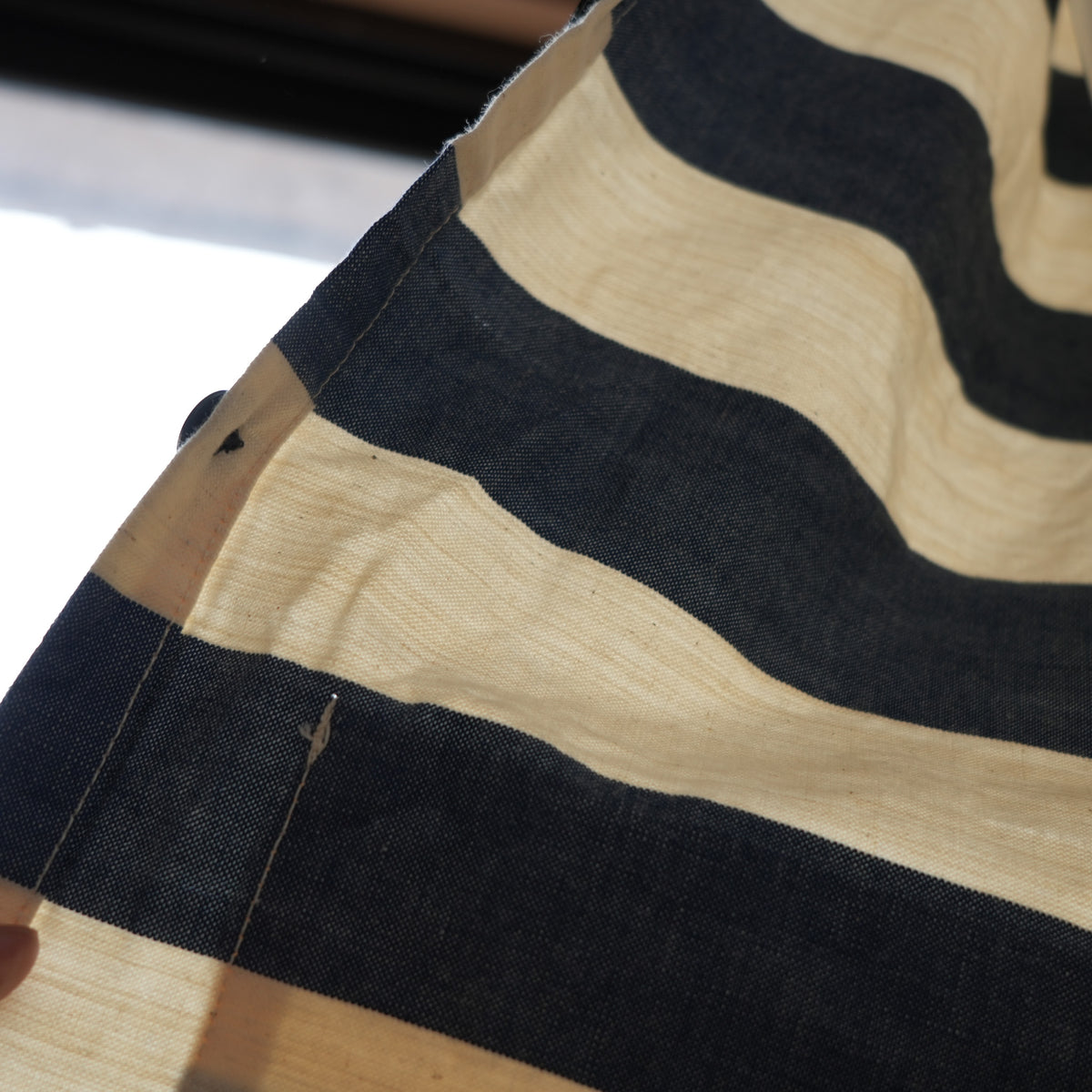
Despite the rough overall construction, the front closures and stripes were strangely perfectly aligned. I observed it, thinking, "They were meticulous only here," and realized—
It was actually a one-piece construction where the front and back body panels were all connected. It was only natural that the patterns would align (laughs).
Ultimately, it is a jacket made with a surprisingly simple structure of one body piece, two sleeve pieces, and one collar piece. Yes, it is clothing "made to be worn, not to be sold."
For TCB, which has customers all over the world, this project is not just a reproduction. Through the subject of "prison uniforms," it is an attempt to reinterpret universal themes—freedom, responsibility, and identity—as fashion.
Just like denim, uniforms carry the "evidence of a life lived."
That is what TCB believes.
That is why I want to send this clothing out into the world not as a negative symbol, but as a positive message that symbolizes "the strength to seek freedom."
□ Fabric
This is an original custom-made fabric for the SING SING Cabaret Jacket.
Actually, it’s cut across the grain. In roll form, it is originally a vertical stripe fabric. We intentionally cut it horizontally so that it finishes as a border pattern.
The reason this doesn't feel out of place is because of the fabric structure: duck (plain weave).
10-count warp x 16-count weft, approx. 10 ounces.
It has a sturdy weave but retains a soft texture.
We used high-grade Zimbabwean cotton for the raw material, but our goal wasn't "high quality"—it was the rough texture of what was issued to prisoners at the time. For this reason, we used slab yarn with strong irregularities that we don't usually use for TCB jeans. The wild yet warm expression perfectly reproduces the reality of the era.
Regarding the vintage border color (navy), I initially wondered, "Could this be indigo-dyed?"
But if it were indigo, there would have been color transfer to the raw-colored sections. Therefore, we recreated the navy this time using reactive dyeing (cheese dyeing).
Above, reprinted from the official TCB site.
A rather quirky item has arrived.
It’s an item that takes some courage to wear, but please, give it a try.
The sleeves are quite wide, so you could roll them up. It might be interesting to use it as an accent for layered outfits.
Actual size chart: Unit cm
| Size | 34 | 36 | 38 | 40 | 42 | 44 |
| Shoulder Width | 45.0 | 47.3 | 50.5 | 51.0 | 53.5 | 56.0 |
| Length | 68.5 | 69.8 | 71.0 | 72.5 | 75.0 | 77.5 |
| Chest Width | 54.3 | 56.8 | 59.0 | 60.8 | 63.0 | 65.0 |
| Sleeve Length | 60.3 | 61.5 | 63.3 | 64.3 | 66.0 | 66.5 |
| Cuff Width | 15.0 | 15.3 | 16.0 | 16.5 | 16.8 | 17.0 |
Trying on at the store
Trying on at the store
In-store try-ons are offered as a service to customers who are considering purchasing from our store.
Please refrain from trying on items solely for the purpose of size confirmation.
Items such as cut-and-sew garments, which are prone to stretching, cannot be tried on. Exchanges after trying on at home post-purchase are also not accepted.
Please also refrain from trying on belts, as they tend to stretch. For length confirmation, please bring a belt you are currently using.
For leather boots and sandals, try-ons are also offered on the premise of purchase. Please try them on during the final confirmation stage. When trying on, please be careful not to cause wrinkles. Please be sure to bring your own socks.
We appreciate your understanding and cooperation to ensure everyone can enjoy using our services comfortably.
No Forwarding Services
No Forwarding Services
We do not ship to freight forwarding addresses.
Please note that if the shipping address provided is identified as a freight forwarder after an order has been placed, your order will be cancelled.
Customs Duties & Taxes
Customs Duties & Taxes
Please note that international orders may be subject to customs duties, taxes, and import fees upon arrival in your country. These charges are the responsibility of the recipient and are not included in the item price or shipping cost.
We recommend checking with your local customs office for more information about applicable fees before placing your order.
International Shipping
International Shipping
Please note that the international shipping cost shown at checkout is an estimate. After your order is placed, we will calculate the exact shipping cost based on the destination, package size, and weight.
- If the actual shipping cost is lower than the estimated amount, we will adjust the shipping charge to the correct amount and finalize your payment accordingly.
- If the actual shipping cost is the same as the estimated amount, your order will be processed without any changes.
- If the actual shipping cost is higher than the estimated amount, we will contact you before processing your order.
- Please note that some destinations may be subject to a Remote Area Surcharge imposed by the shipping carrier. If applicable, only the actual surcharge charged by the carrier will be billed separately.
Please note that the international shipping cost shown at checkout is an estimate. After your order is placed, we will calculate the exact shipping cost based on the destination, package size, and weight.
- If the actual shipping cost is lower than the estimated amount, we will adjust the shipping charge to the correct amount and finalize your payment accordingly.
- If the actual shipping cost is the same as the estimated amount, your order will be processed without any changes.
- If the actual shipping cost is higher than the estimated amount, we will contact you before processing your order.
- Please note that some destinations may be subject to a Remote Area Surcharge imposed by the shipping carrier. If applicable, only the actual surcharge charged by the carrier will be billed separately.
Customs Declaration
Customs Declaration
We are unable to declare a lower value on customs invoices or shipping documents, regardless of customer request.
Accurate customs declarations are required by law. Declaring a false value may violate the import laws and regulations of the destination country. We appreciate your understanding and cooperation.
当店では、お客様のご要望であっても、インボイス(税関申告書)や発送書類に記載する商品価格を実際の購入金額より低く設定することはお断りしております。
正確な税関申告は法律上の義務であり、虚偽の申告は輸入国の法律や規制に違反する可能性があります。何卒ご理解くださいますようお願いいたします。
Share