TCB Jeans
TCB Jeans_Cat Head Jacket
TCB Jeans_Cat Head Jacket
Couldn't load pickup availability
□Encountering the Original
I wanted to create a new coverall for spring, and I started my search for an original design early last year. Although I gradually narrowed down the target I wanted to create, I couldn't find the actual one I was looking for. Amidst this, during a casual chat, I mentioned to Ryo, who works in the same room as me, "It would be cute if a 1930s Duck Head coverall came up, I'd love to make one." He then replied, "I bought one when I lived in Holland, and I gave it to my dad, so he has it now." It was an incredible coincidence, and when I expressed my desire to use that vintage item as the target, he readily agreed, and the project began.
□Attention to Detail
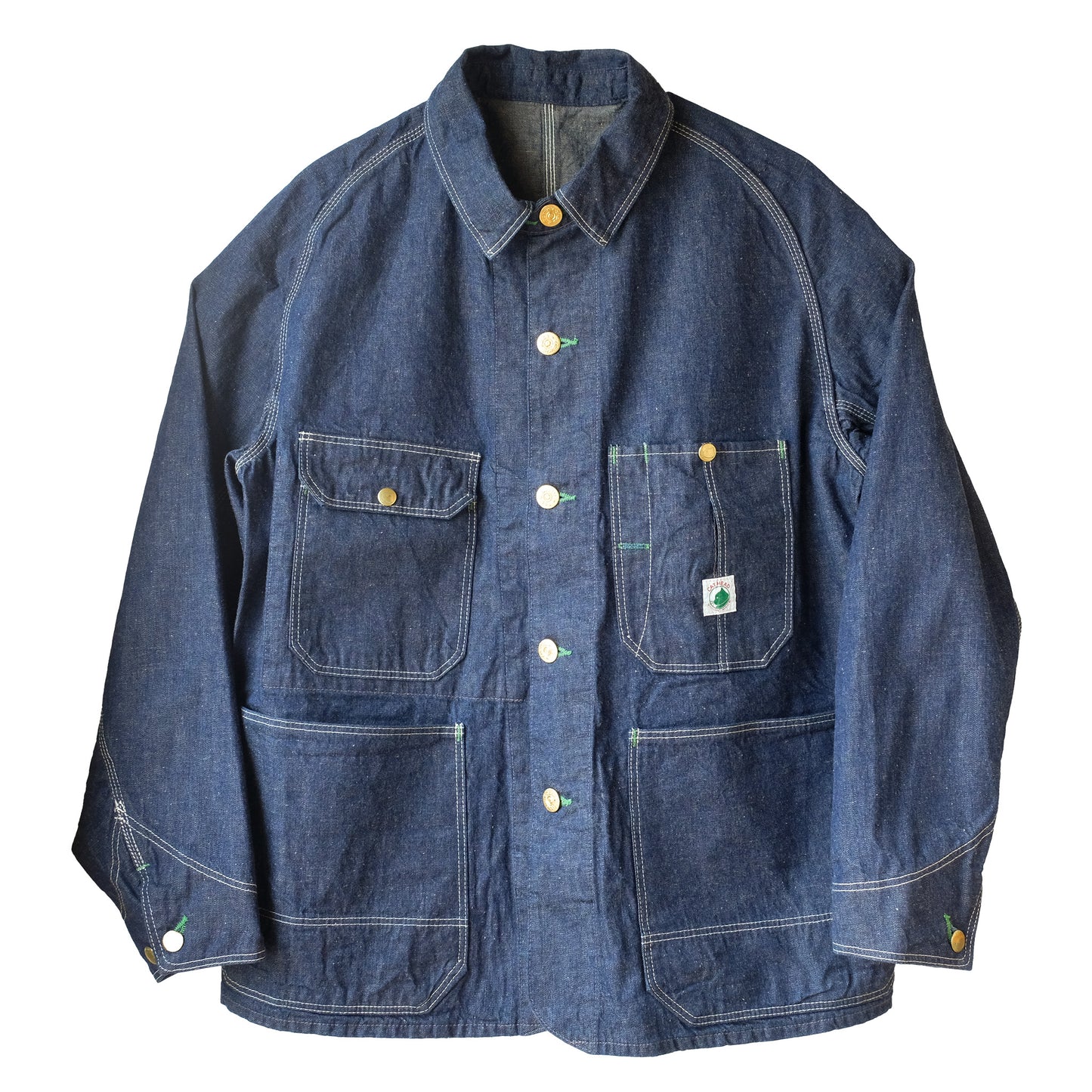
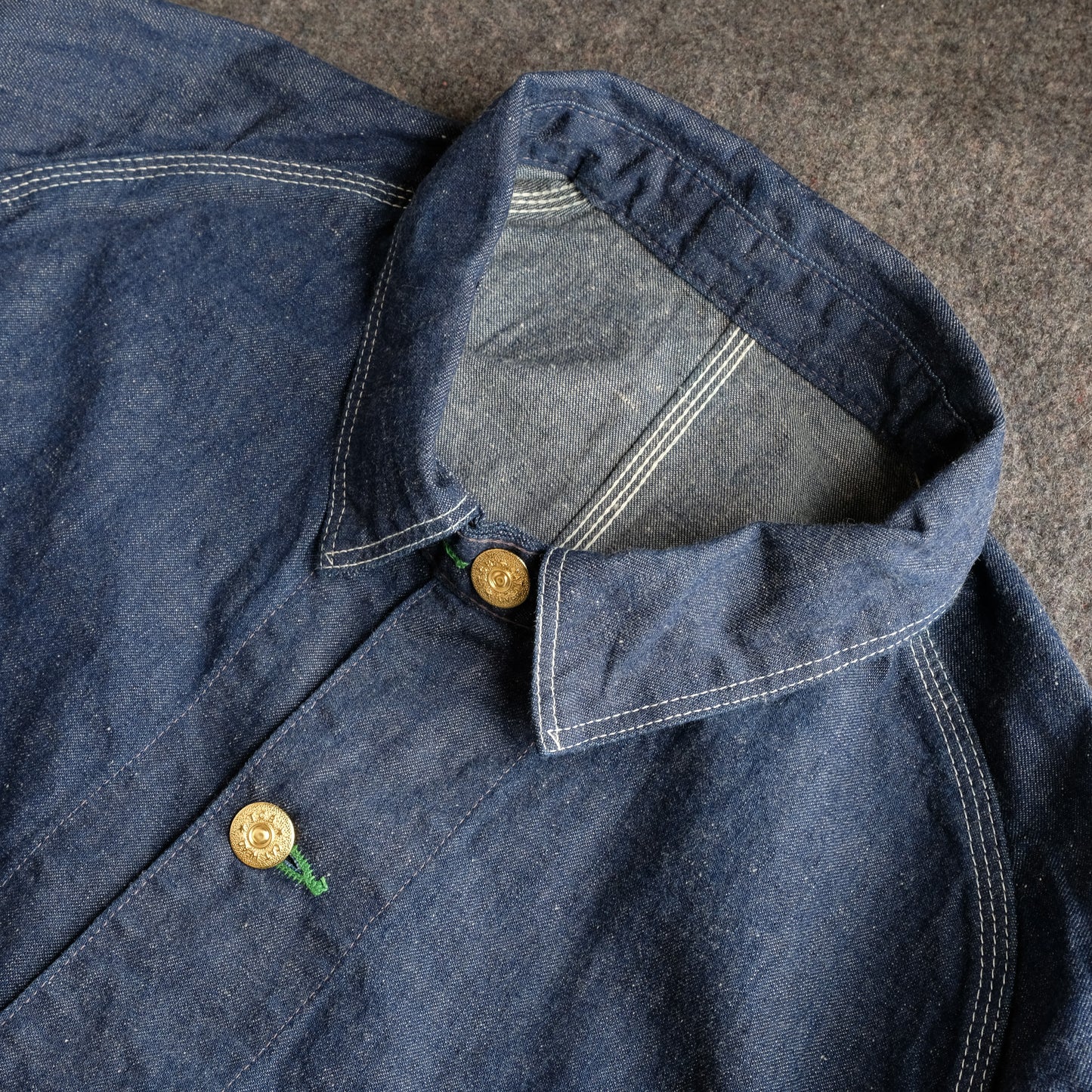
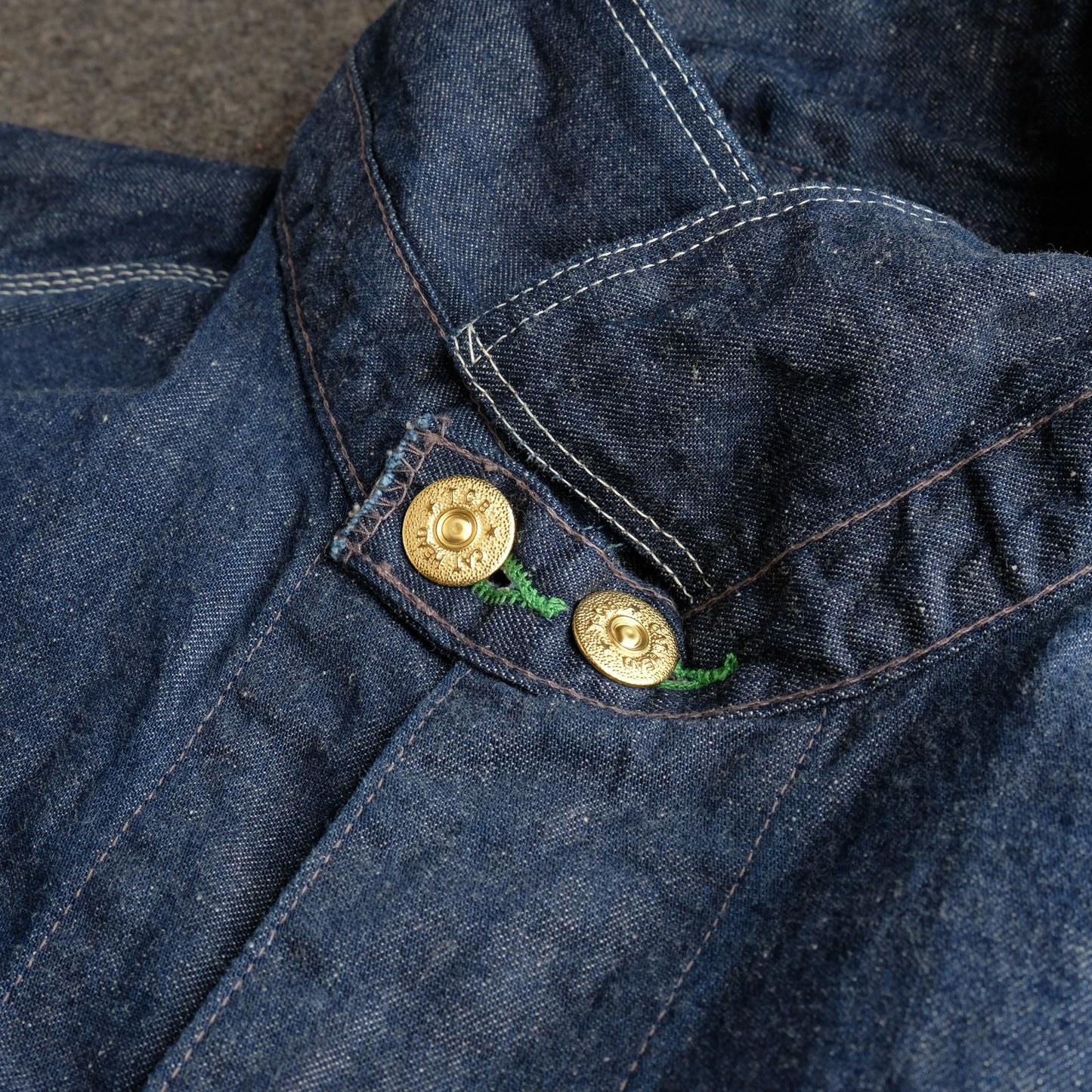
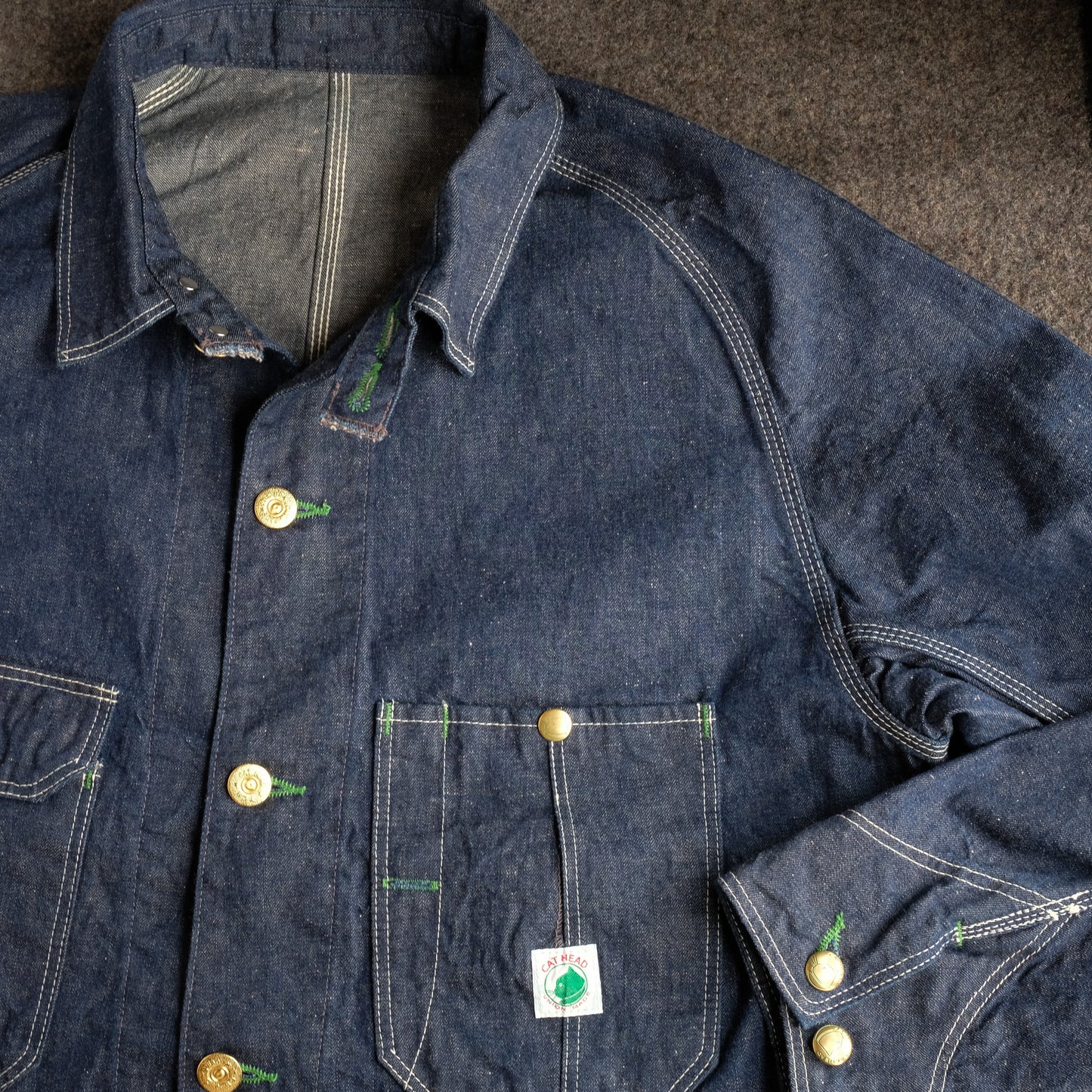
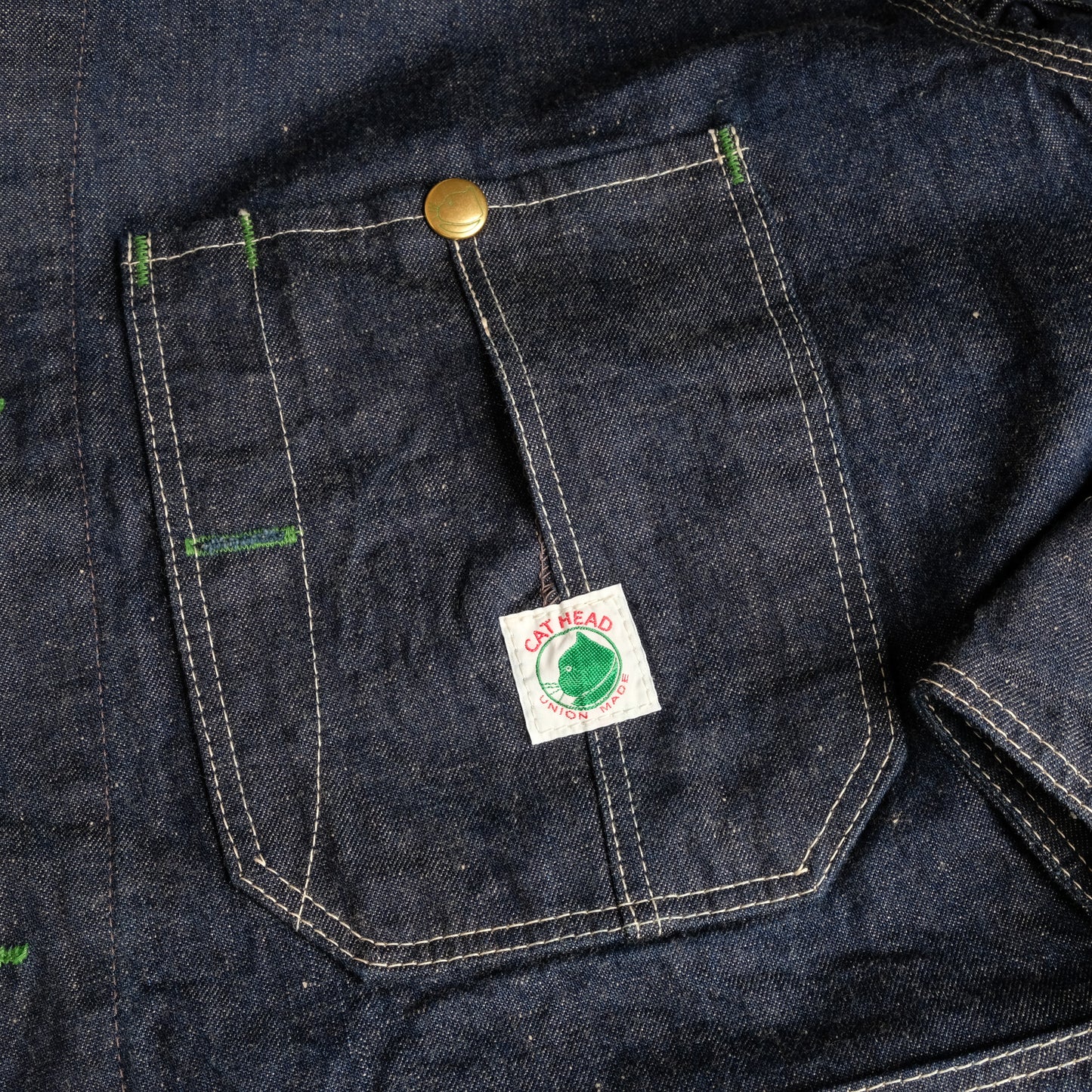
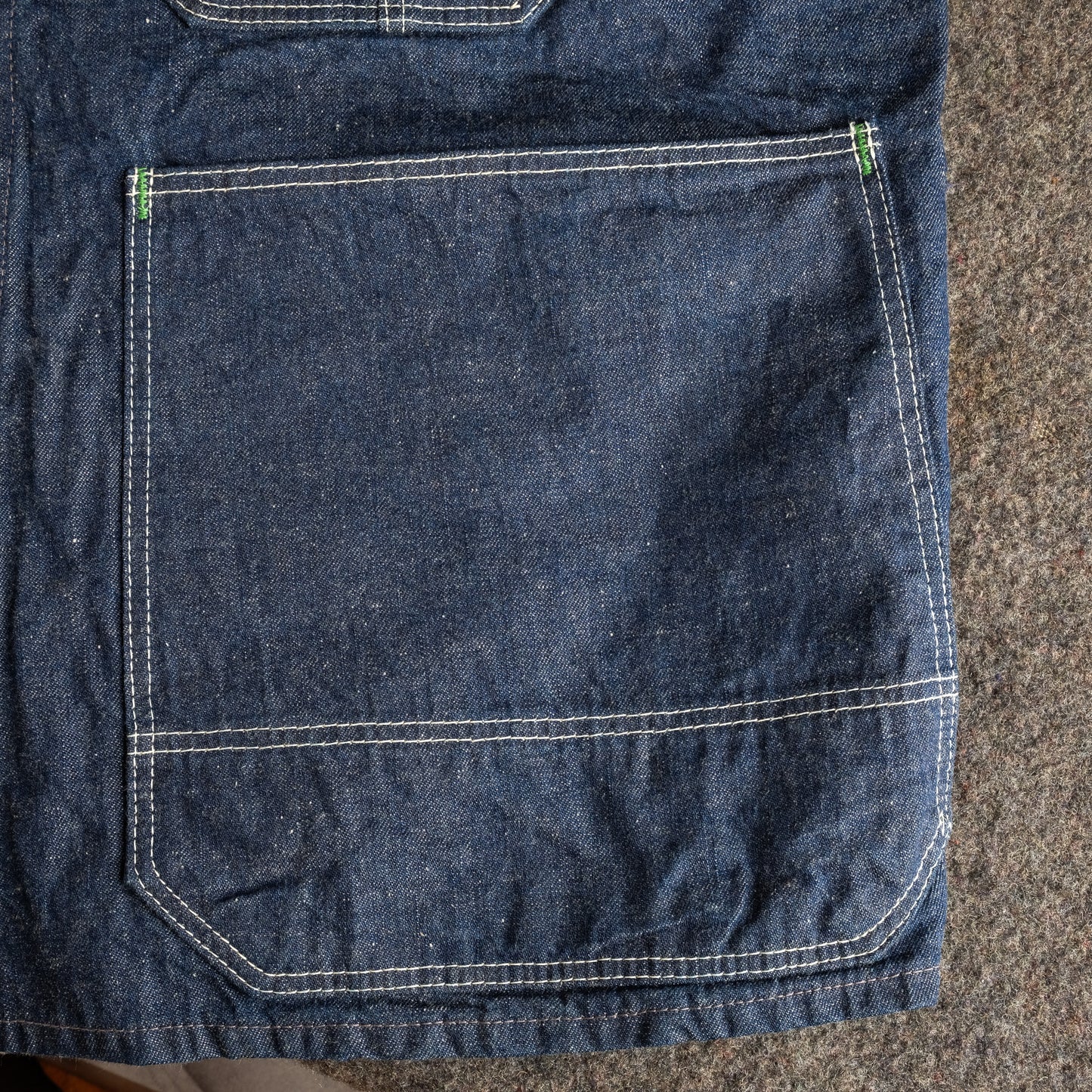
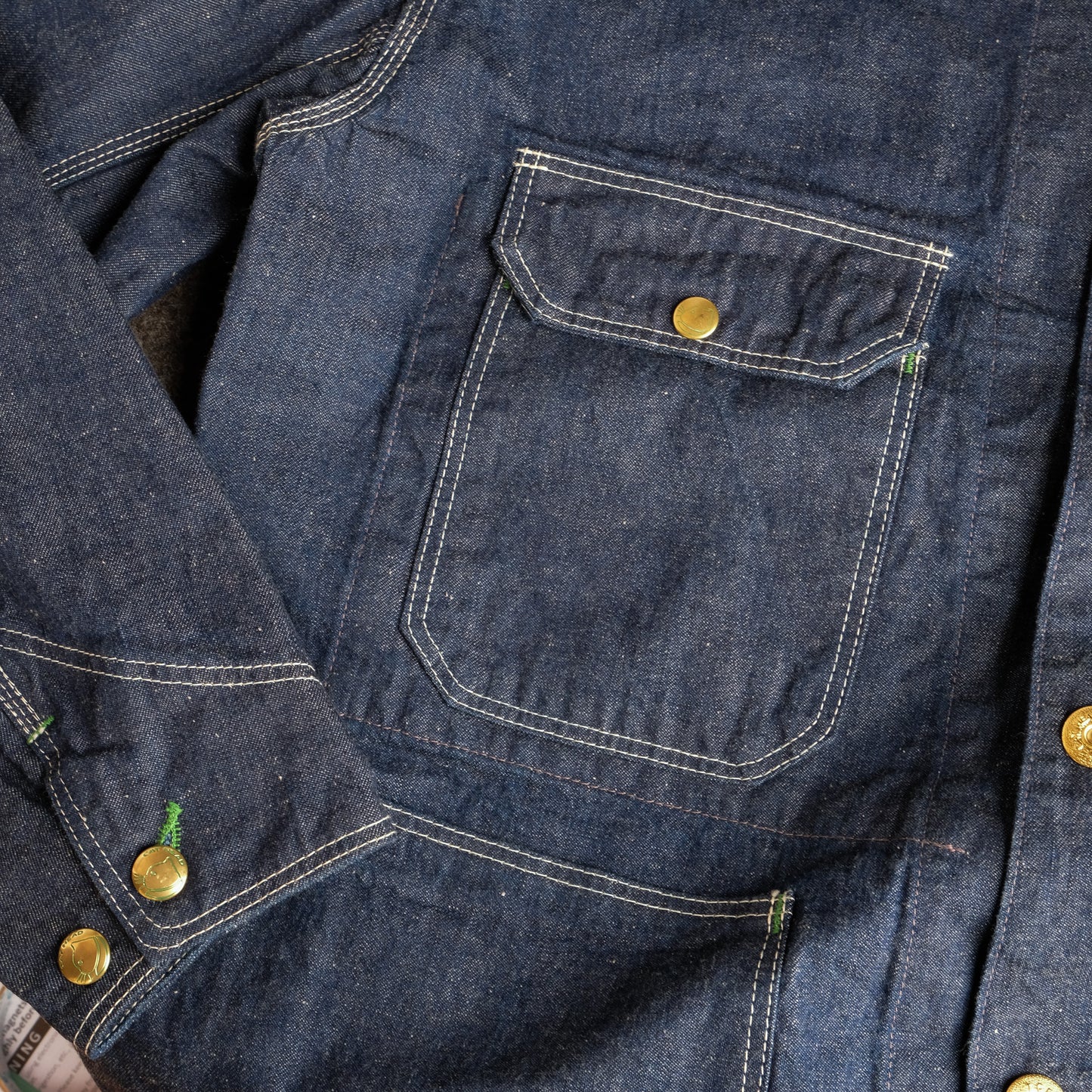
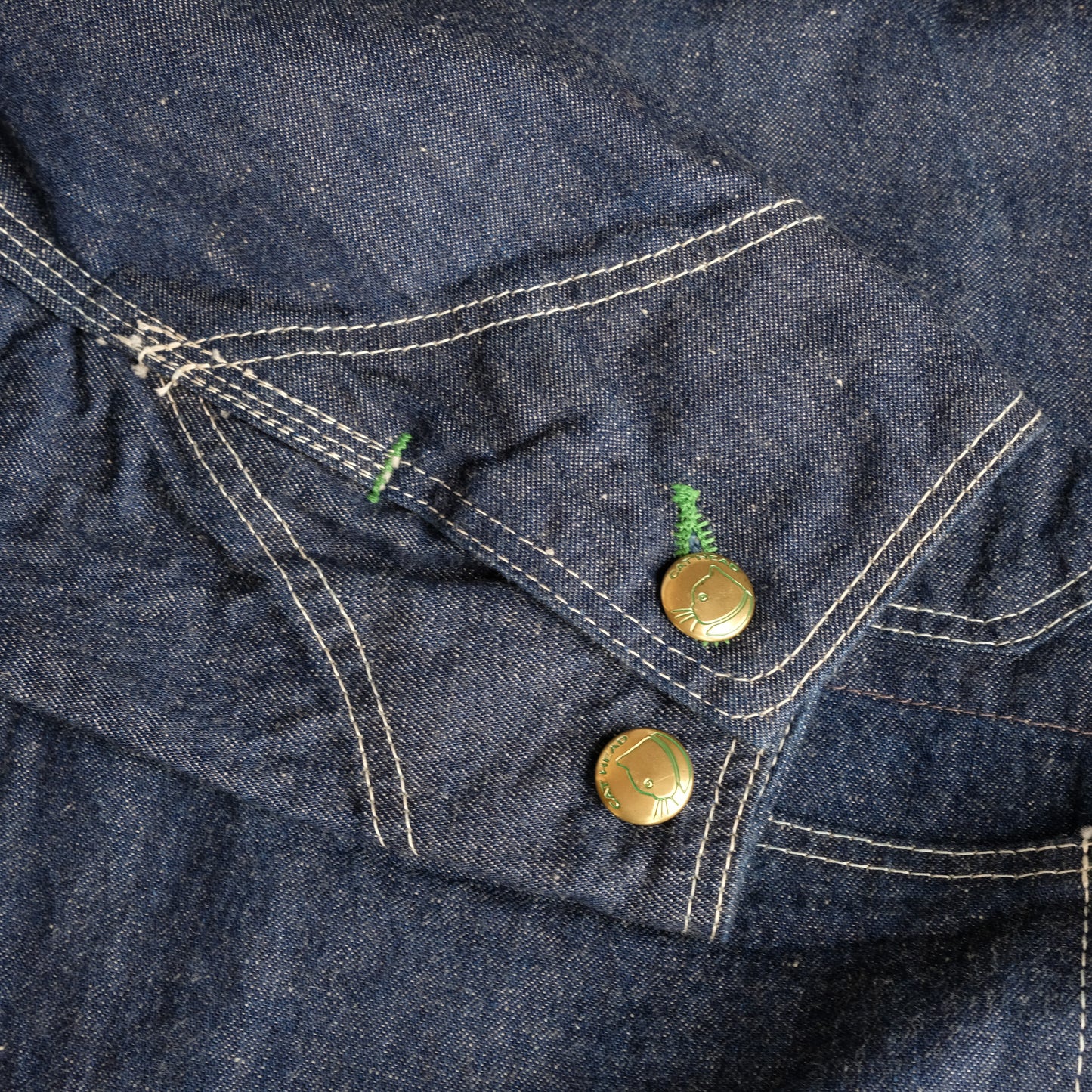
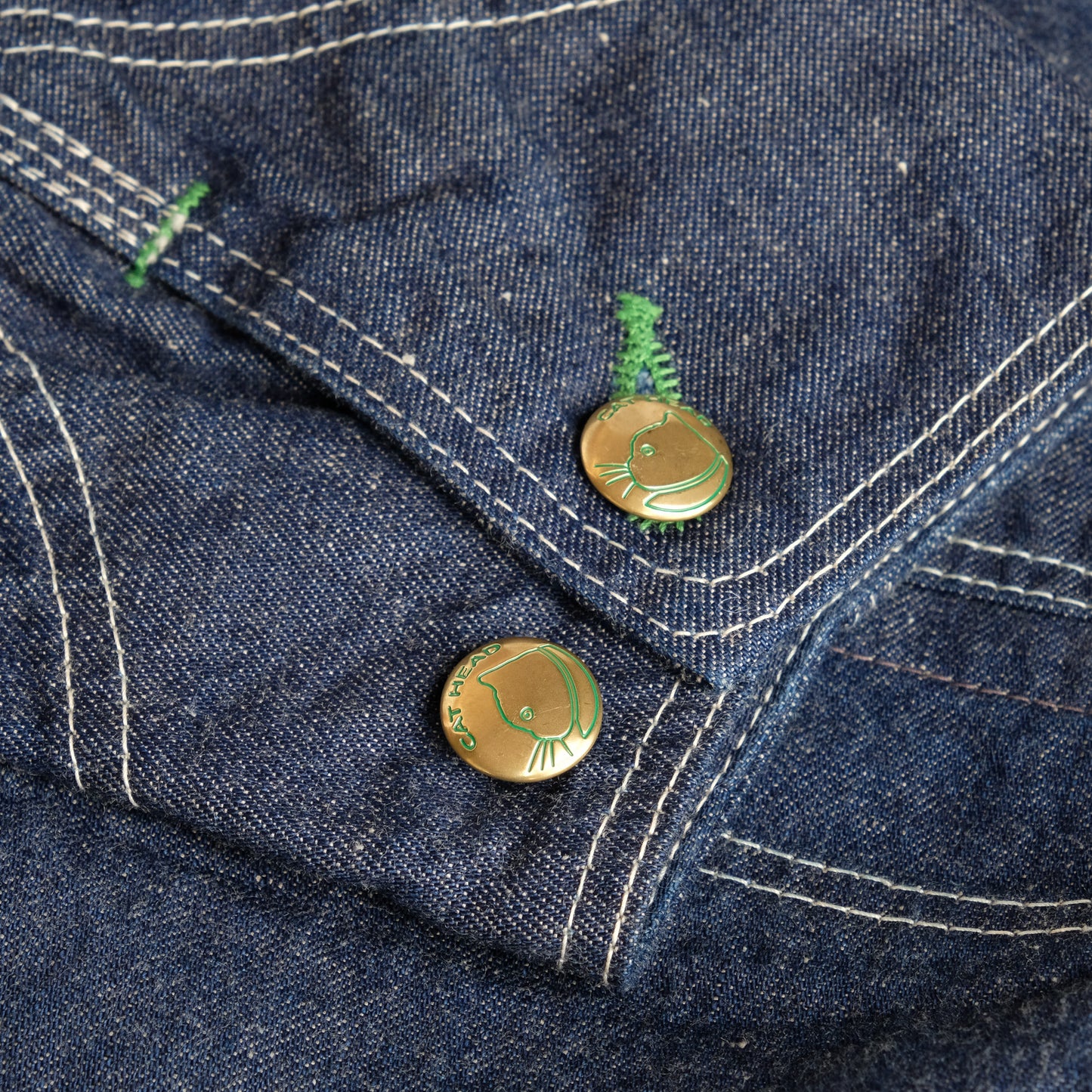
When I talk about coveralls, as I often write, I love the distinctive left chest design of the 1930s. While not as much as the Black Bear, Strong Hold, or Boss of the Road coveralls I've created in the past, this one also features an asymmetrical design. The most captivating aspect was the endearing, slightly funny duck face. I've always loved animal motifs in vintage logos, and there's no end to listing them: the bulldog from Boss of The Road, the chicken from Can't Bust'em, the bear from Black Bear, the pig from Finks, and so on – they are all charming details. To recreate this atmosphere, I had the design redrawn many times, changing the original funny duck face to a cat. As a result, this tag's cat turned out wonderfully, and the two-prong snap buttons on the chest and the dome-shaped tack buttons on the sleeves also have a charming finish while recreating the vintage feel. The buttons on the placket reproduce the same pear-skin texture found on vintage items. The rough texture prevents slipping and makes them easy to attach and detach. I believe this aspect is also a result of prioritizing functionality rather than just design.
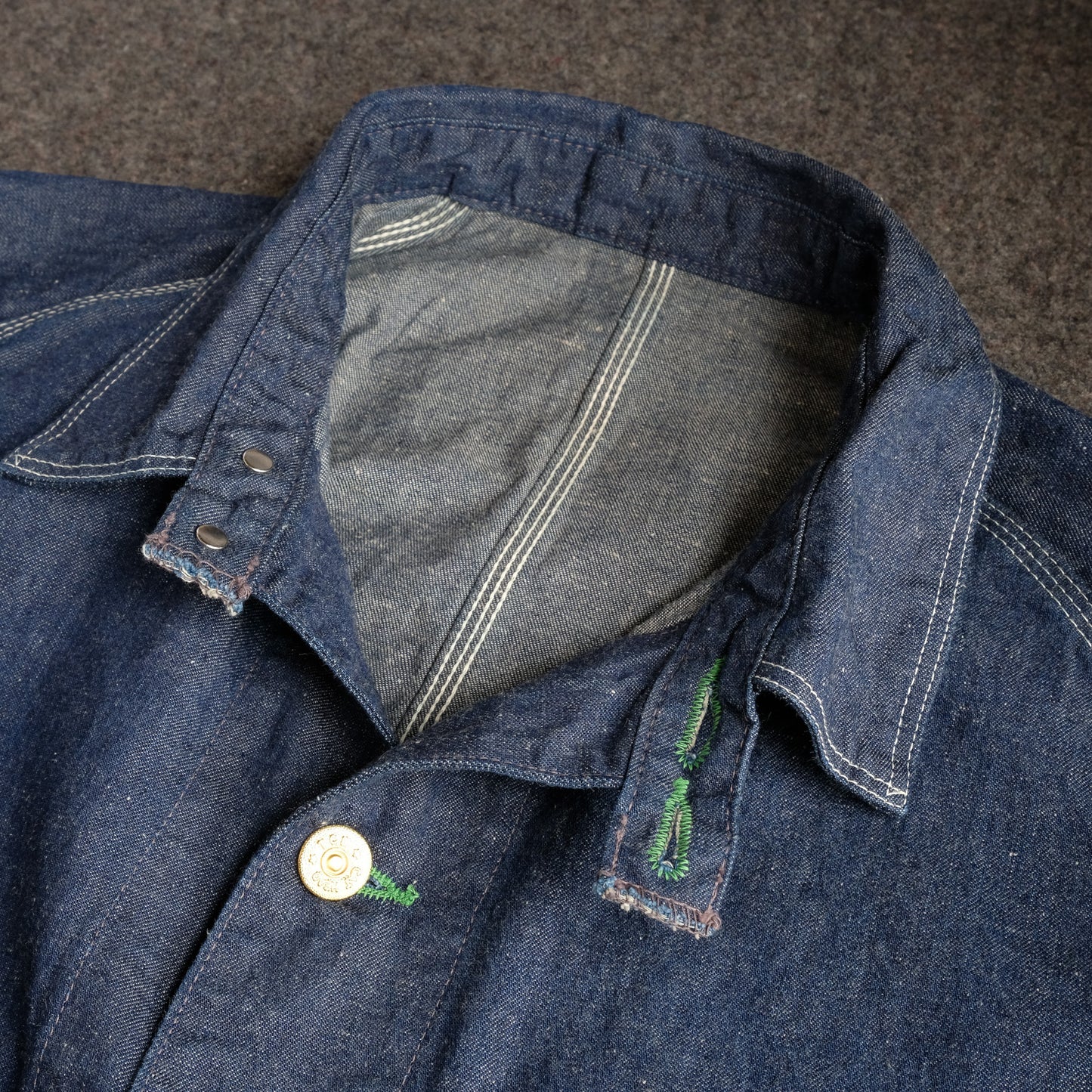
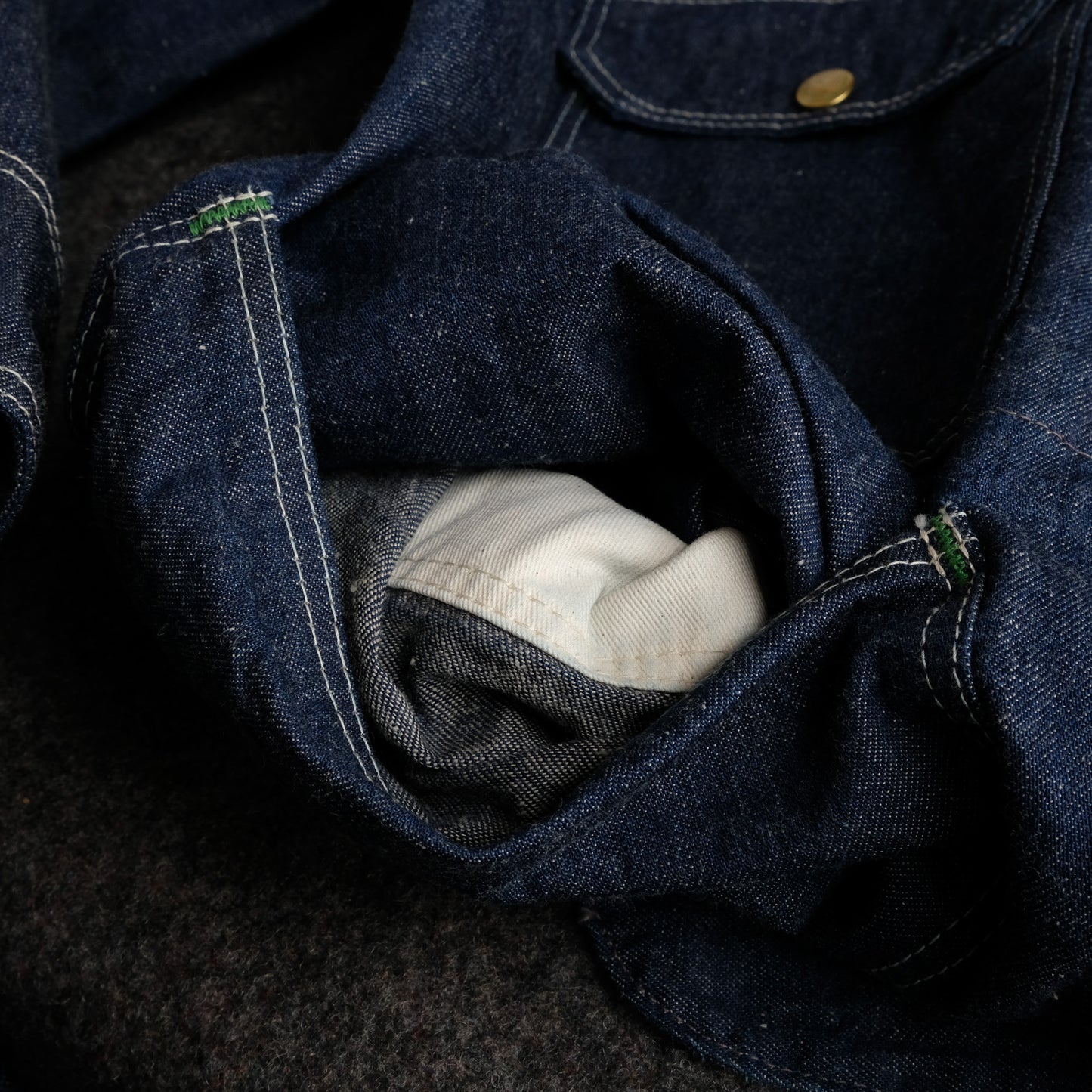
Another appealing feature was the green bartacks and buttonholes. Many vintage items have colorful bartacks, and at TCB, we've enjoyed using colors we've seen before or trying out colors that seem plausible yet unique for bartacks. However, when it comes to colorful buttonholes, I can only recall Duck Head and Oshkosh at the moment. Of course, they might seem vivid at first, but watching the green fade with continued wear might also be a joy of this jacket.
□Fabric and Sewing Techniques
A distinctive sewing detail was the chin strap made with a chain stitch on the stand collar. This process had given me and the executive director a lot of thought. However, when I consulted with Tateno-san of Workers, who is also a comrade, he mentioned that he had created a special attachment for a Payday-inspired piece two years ago. We gratefully accepted his offer to "feel free to use it at TCB." The fact that the stand collars of Payday and Duck Head are interchangeable shows that what we considered design elements were actually byproducts born from the constraints of sewing machines, viewed from a manufacturing perspective.
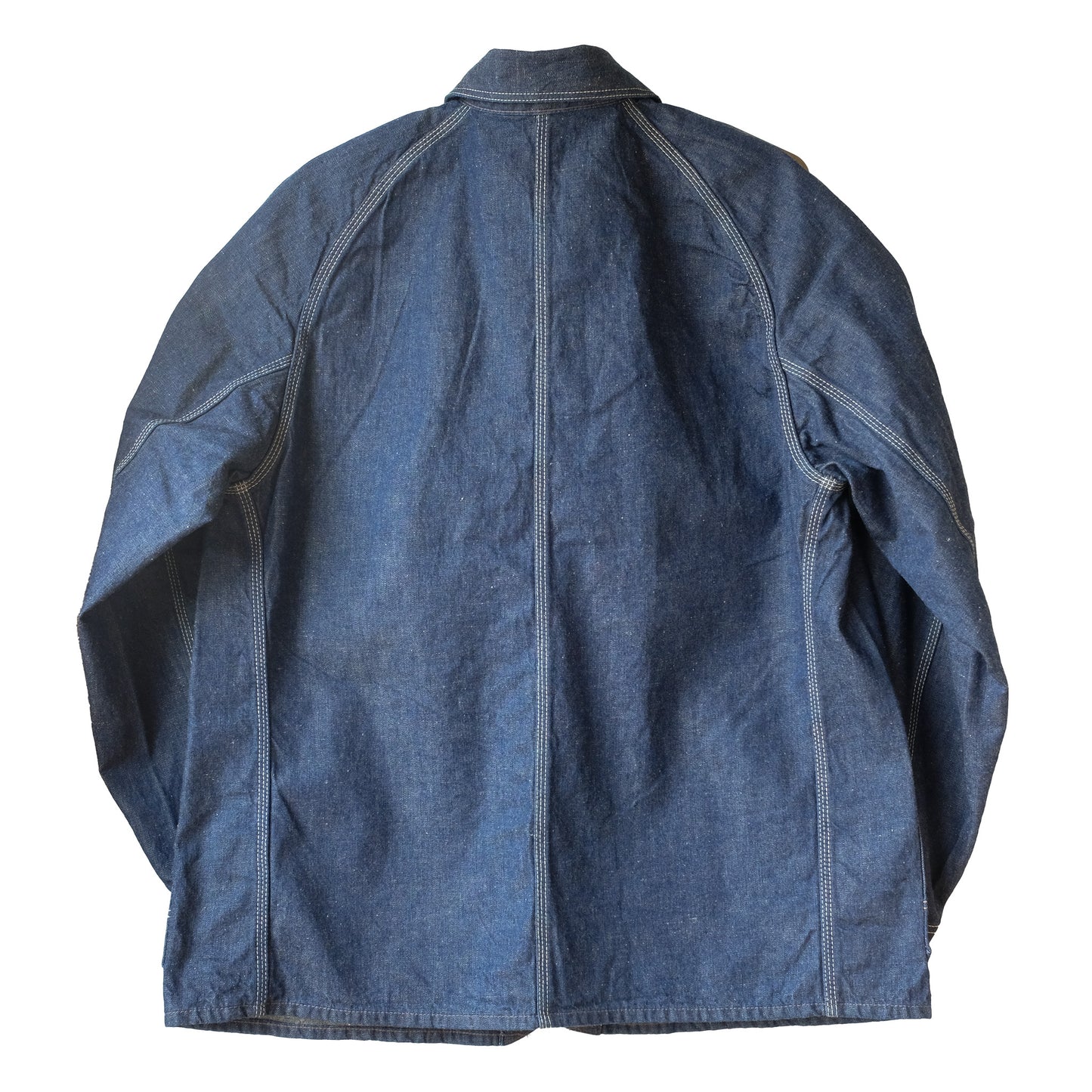
When TCB makes coveralls, we shorten the length slightly compared to vintage pieces to make it easier to balance with a denim top and bottom. Since it's a raglan sleeve, it doesn't feel constricting even when worn true to size, and it offers a wide range of arm movement. We also paid close attention to the fabric, referencing vintage materials down to the thread irregularity, color, and dyeing method. Recently, instead of expressing irregularity with a single yarn count, we've opted for a method of mixing different yarns to vary their irregularity. Specifically, for the warp, we use an 8-count straight yarn and a 9-count yarn with short slubs in a 1:1 ratio. For the weft, we use a 12-count natural slub yarn and another 12-count yarn with neps in a 1:1 ratio. As a result, by using four types of yarn, it achieves a vintage look. The dyeing was also done with the lighter shade characteristic of store brands. Instead of a light reason for the warp, the weft is dyed gray instead of ecru. This approach, to hide dirt, likely led some companies to insist on darker warps, while others chose to dye the weft gray to make the fabric appear darker and thus hide dirt.
For the finish, since nep yarn is used for half of the weft, it is finished without singeing.
□Regarding Sizing
The basic sizing is created to match TCB's standard coverall, the Cathartt Chore Coat. When comparing it to a denim jacket, we recommend sizing down by 1-2 sizes, depending on your preferred fit.
The above is reproduced from TCB official.
Above all, this vintage-like cat button is an irresistible detail. Why are old designs so charming, you might wonder when looking at vintage items, but perhaps it's because the original drawings were hand-drawn. That's what I personally believe.
No matter how much technology evolves, I believe there's a "goodness" in hand-drawn art that AI can't achieve. That said, to mass-produce buttons, hand-drawn designs are, of course, digitized for production.
With the drastic temperature changes these days, a coverall that can be easily worn when needed is extremely convenient. Its moderate thickness allows for year-round use.
Actual size chart: unit cm
| Size | 34 | 36 | 38 | 40 | 42 | 44 |
| Yukitake (Sleeve length from center back) | 79.5 | 81.0 | 83.5 | 88.0 | 86.5 | 88.5 |
| Length | 63.0 | 65.5 | 68.0 | 72.3 | 71.5 | 71.0 |
| Width | 56.3 | 58.5 | 61.0 | 63.0 | 62.0 | 67.5 |
| Cuff width | 10.3 | 10.8 | 11.5 | 12.3 | 11.8 | 12.3 |
Trying on at the store
Trying on at the store
In-store try-ons are offered as a service to customers who are considering purchasing from our store.
Please refrain from trying on items solely for the purpose of size confirmation.
Items such as cut-and-sew garments, which are prone to stretching, cannot be tried on. Exchanges after trying on at home post-purchase are also not accepted.
Please also refrain from trying on belts, as they tend to stretch. For length confirmation, please bring a belt you are currently using.
For leather boots and sandals, try-ons are also offered on the premise of purchase. Please try them on during the final confirmation stage. When trying on, please be careful not to cause wrinkles. Please be sure to bring your own socks.
We appreciate your understanding and cooperation to ensure everyone can enjoy using our services comfortably.
No Forwarding Services
No Forwarding Services
We do not ship to freight forwarding addresses.
Please note that if the shipping address provided is identified as a freight forwarder after an order has been placed, your order will be cancelled.
Customs Duties & Taxes
Customs Duties & Taxes
Please note that international orders may be subject to customs duties, taxes, and import fees upon arrival in your country. These charges are the responsibility of the recipient and are not included in the item price or shipping cost.
We recommend checking with your local customs office for more information about applicable fees before placing your order.
International Shipping
International Shipping
Please note that the international shipping cost shown at checkout is an estimate. After your order is placed, we will calculate the exact shipping cost based on the destination, package size, and weight.
- If the actual shipping cost is lower than the estimated amount, we will adjust the shipping charge to the correct amount and finalize your payment accordingly.
- If the actual shipping cost is the same as the estimated amount, your order will be processed without any changes.
- If the actual shipping cost is higher than the estimated amount, we will contact you before processing your order.
- Please note that some destinations may be subject to a Remote Area Surcharge imposed by the shipping carrier. If applicable, only the actual surcharge charged by the carrier will be billed separately.
Please note that the international shipping cost shown at checkout is an estimate. After your order is placed, we will calculate the exact shipping cost based on the destination, package size, and weight.
- If the actual shipping cost is lower than the estimated amount, we will adjust the shipping charge to the correct amount and finalize your payment accordingly.
- If the actual shipping cost is the same as the estimated amount, your order will be processed without any changes.
- If the actual shipping cost is higher than the estimated amount, we will contact you before processing your order.
- Please note that some destinations may be subject to a Remote Area Surcharge imposed by the shipping carrier. If applicable, only the actual surcharge charged by the carrier will be billed separately.
Customs Declaration
Customs Declaration
We are unable to declare a lower value on customs invoices or shipping documents, regardless of customer request.
Accurate customs declarations are required by law. Declaring a false value may violate the import laws and regulations of the destination country. We appreciate your understanding and cooperation.
当店では、お客様のご要望であっても、インボイス(税関申告書)や発送書類に記載する商品価格を実際の購入金額より低く設定することはお断りしております。
正確な税関申告は法律上の義務であり、虚偽の申告は輸入国の法律や規制に違反する可能性があります。何卒ご理解くださいますようお願いいたします。
Share